
A replacement module out of the box does nothing. It has no VIN, no calibration file, and no memory of the vehicle it is about to control. Getting it from that state to a car you can hand back is a different job depending on which module you are holding, and shops that treat all three the same way end up with a programmed part and a vehicle that still will not drive.
The flash itself is the part all three jobs share. What comes before and after it is where they split, and where the tool on your bench either finishes the work or stops halfway.
Why One Tool Rarely Covers All Three
Federal emissions rules push manufacturers to make engine and emissions-related reprogramming available through J2534 pass-thru. Transmission control falls inside that scope on most platforms, since shift strategy and torque converter lockup affect emissions, and on plenty of vehicles the transmission is controlled by the PCM anyway. Brake, body, and chassis modules are the ones that sit outside it for a lot of brands. A pass-thru setup that flashes a PCM every day can stop cold when you move to an EBCM, and the job hands off to OEM software or an aftermarket tablet with that manufacturer's coverage licensed in.
Transmission work splits a different way. The flash is usually covered; the adaptive relearn afterward is what your tool may not be able to command.
That gap is the reason most shops end up with more than one path to a flash. If you are still sorting out the hardware standard itself, J2534 pass-thru programming tools covers how those devices work and what to look for. What follows picks up after that, at the module level.
Programming an ECM or PCM
Engine control is the most documented of the three, and the most forgiving, because the J2534 mandate covers it on nearly every make.
The sequence usually goes:
- Pull the VIN and look up the calibration the vehicle calls for before you order the part
- Write the VIN and configuration data as part of the manufacturer's programming routine, which handles those steps in its own order (GM SPS uses the VIN to pick the calibration, then a separate setup pass; Ford's PMI writes VIN and configuration during programming)
- Perform the anti-theft or immobilizer relearn (PATS on Ford, Passlock and its PK3 and BCM-based successors on GM, SKIM and SKREEM on older Chrysler, the WCM or RF Hub on anything from roughly 2007 forward)
- Wait out any security timer the brand imposes, which can add ten to thirty minutes
- Confirm the flash took, clear codes, and tell the customer the readiness monitors need a drive cycle before the car will pass an emissions test
The trap: an ecm reprogramming tool that handles the flash but cannot perform the immobilizer relearn leaves you with a module that talks and an engine that will not start. Confirm both functions on the coverage list, not just programming.
Programming an ABS Module
Brake module work has the longest tail of post-programming steps, and it is where shops lose the most time.
A new EBCM often arrives blank and needs configuration for what the vehicle came with: traction control, hill start assist, trailer sway control, and electronic parking brake all change how the module behaves. Once it is programmed, the module still has no idea where the wheels are pointed or what the chassis is doing. That means:
- Steering angle sensor calibration, plus a yaw rate and lateral acceleration sensor zero point learn on most platforms
- Brake pressure sensor zero point
- An automated bleed driven through bidirectional control if you opened the hydraulic unit or replaced the EBCM and HCU as a combined assembly, which is how many of them are sold. Swapping the controller alone introduces no air and needs no bleed
- A road test to confirm the stability control light stays out under load
An abs module programming tool without bidirectional bleed support puts you in the worst position on this list: the module is programmed, the codes are gone, and the pedal is still spongy. Bidirectional coverage for the make you work on matters more here than raw programming speed.
Programming a TCM
Transmission modules carry something the other two do not, which is a set of learned values built up over thousands of shifts. Line pressure, clutch fill times, and shift adaptives are stored in the module, so a new one starts with factory defaults and no history.
Flashing it is the easy half. The rest:
- A quick learn or adaptive reset procedure, which differs by brand and sometimes by transmission family
- Fluid temperature inside a set window before the relearn will start, which on some platforms means a warm-up drive first
- VIN write plus configuration for tire size and axle ratio on trucks
- A drive cycle to relearn shift points
A transmission control module programming tool that flashes but cannot execute the relearn hands the customer a car that shifts hard for the first hundred miles, and they will be back. Look for the relearn procedure by name in the coverage list.
OEM Software vs. Aftermarket Tablets
There are two ways to get here, and shop volume decides which one pays.
OEM software with a matched interface gives you everything the dealer has, including the chassis and body modules that fall outside J2534. You subscribe per brand, per term, and you connect through that brand's own hardware, which is why the interface is brand by brand rather than one box for everything. The full lineup is below. If most of your work sits in one or two brands, this is the cheaper path within a year, and why OEM scan tools are the standard goes deeper on that math.
An aftermarket tablet with a programming interface gives you one ECU reprogramming tool that covers many makes from a single screen, and it handles the bidirectional work that ABS and TCM jobs need. Coverage depth per brand is thinner than dealer software, but for a general repair shop seeing eight makes a week, the breadth wins.
Most shops doing steady module work end up owning both, using the tablet for diagnosis and the routine flashes, and the OEM subscription for the jobs the tablet will not finish.
Power Is Where Flashes Fail
A flash can take twenty minutes or longer, and system voltage has to hold steady the whole time. A battery that sags mid-write can leave a module half-programmed and unrecoverable, which turns a $400 part into an $800 mistake plus a tow.
A shop charger is not the same thing as a programming supply. What you want is a maintainer that holds a flat line under load without the ripple a standard charger puts out. The PowerMax PMBC-75-SE at $389 handles this for most bays, and the GYSFLASH HF units cover higher-draw work on 12V and 24V. Note that the 48V GYSFLASH models are traction battery chargers for EV and material handling work, not programming supplies, so match the model to the job.
Where ADAS Calibration Comes In
Steering angle sensor calibration is a chassis step, and it reaches further than the brakes. The sensor broadcasts on the chassis bus, and stability control, electric power steering, lane keeping assist, and lane centering all consume the same signal. Get the zero point wrong after an EBCM job and the lane keeping behavior goes with it.
That is the direct link. A camera or radar calibration is a separate trigger, and it comes from windshield replacement, sensor removal or disturbance, an alignment or ride height change, or collision damage, not from swapping a brake module. Check the OEM position statement for the platform in front of you rather than assuming either way, because a miscalibrated sensor logs no codes and still leaves the system doing the wrong thing.
Programming Tools We Carry at ADAS Depot
Multi-Brand Pass-Thru Programmers
- Autel MaxiFLASH VCMI, $1,800. A J2534-1 and J2534-2 pass-thru programmer with a 4-channel oscilloscope, DVOM, waveform generator, and CAN bus tester in the same box. Supports CAN FD and DoIP, and programs BMW and Mercedes through the MaxiSYS Ultra and MS919 tablets.
- Autel MaxiFLASH XLINK, $1,395. A 3-in-1 that works as a VCI, a J2534 programmer, and a remote diagnostic link when a job needs outside support.
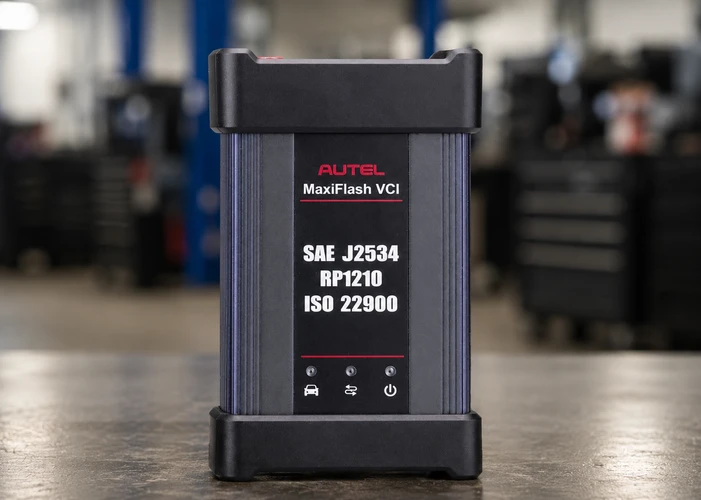
- Autel MaxiFlash Elite / MF2534, $1,195 on sale from $1,495. A straightforward ECM programmer tool for shops that already have a tablet and need the flashing side covered.
OEM Vehicle Communication Interfaces
When the module falls outside pass-thru coverage, you need the manufacturer's own interface. We stock the full OEM hardware lineup:
- BMW: ICOM NEXT A, $1,200
- Chrysler, Dodge, Jeep, and Ram: Mopar Diagnostic Pod Plus (MDP+) Hardware Package, $1,850
- Ford, Lincoln, and Mercury: VCM 3 Hardware Dealer Kit, $1,799
- GM: MDI 2, $1,499
- Honda and Acura: Honda Antares Capsule (HAC), $1,300, with setup covered in our Honda and Acura OEM hardware and software guide
- Mazda: VCM II Kit, $2,995
- Subaru: Denso DST-010 OE Diagnostic Interface Kit, $2,095
- Toyota and Lexus: Opus IVS Mongoose-Plus MFC3, $560.63 on sale from $575, or the Bluetooth Mongoose-Plus MFC3-BT at $765.38 from $785
Keeping the Flash Alive
- PowerMax PMBC-75-SE, $389, so none of the above gets wasted on a voltage drop.
Our full diagnostic scan tool lineup has the tablets these interfaces pair with.
ABS, ECM, and TCM Programming FAQ
Can one tool program ABS, ECM, and TCM on every make?
No. Coverage is listed per module type, per brand, and per model year, and the gaps show up most often in brake, body, and chassis modules, particularly on European makes. Check the coverage chart for the exact module you plan to program before you buy.
Do I need OEM software to program an ABS module?
Sometimes. The emissions mandate covers emissions-related reprogramming, which leaves brake modules up to the manufacturer. In practice, coverage is better than that sounds, because the 2014 national Right to Repair agreement committed automakers to make the same diagnostic and repair tools available to independent shops across all systems, with 2018 and newer vehicles reachable through a standardized pass-thru interface. Several brands publish ABS programming that way. Several still hold it back.
What is the difference between programming and coding?
Programming writes new software or a calibration file into a module. An ecu coding tool changes configuration values inside software that is already there, telling the module which options the vehicle has. A new module usually needs both, in that order.
Why does a transmission shift badly right after programming?
The adaptive values reset with the module. Shift quality comes back after the relearn procedure and a drive cycle. If it does not, the relearn either did not complete or never started, which is often a fluid temperature issue.
Can I program a used module from a donor car?
It depends on the brand. Some modules accept a VIN rewrite and a fresh calibration. Others lock to the first VIN they see and cannot be moved, which is common on immobilizer-linked engine modules and on brake modules for certain platforms.
How long does a module flash take?
Twenty minutes is typical, with some engine and transmission modules closer to forty-five. Add the security timer and the relearn, and a straightforward job still occupies a bay for over an hour.
Not Sure Which Path Fits Your Bay?
Our team programs vehicles every day and can tell you whether an OEM subscription or a tablet setup makes more sense for the makes coming through your door. Book a free consultation or call (925) 566-8545.
