
ADAS DEPOT | INDUSTRY INSIGHTS
Washington Just Fined USAA and Allstate $230,000. Here’s What Collision Shops Should Take From It
A major enforcement action and updated claims-handling rules offer an important reminder for repair shops: documentation matters.
Most shop owners don’t spend their days reading insurance commissioner press releases. This one is worth five minutes, though, because it shows what regulators look at when a carrier mishandles an auto claim, and it landed right before Washington rewrote its claims-handling rules for the first time in decades.
What Happened
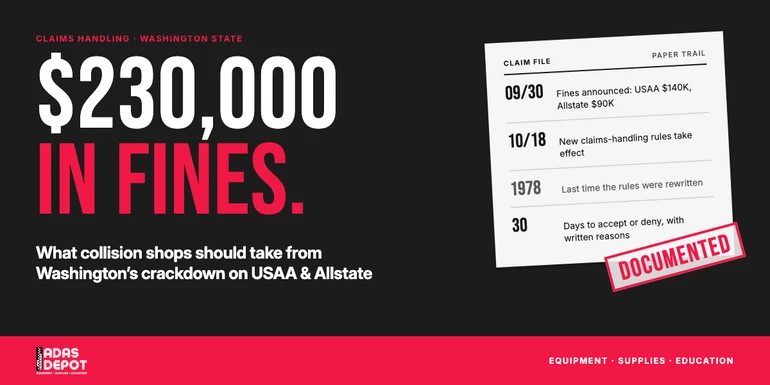
On September 30, Washington Insurance Commissioner Patty Kuderer announced fines totaling $230,000 against two carriers. USAA Casualty Insurance Co. was fined $140,000 for unfair or deceptive practices in how it handled auto claims. Allstate Vehicle and Property Insurance Co. was fined $90,000 for claims-handling violations and for failing to follow the state’s premium change transparency rule.
The details matter, because they show what “unfair claims handling” looks like in practice. After finding 445 consumer complaints against USAA between 2019 and 2024, the OIC reviewed 125 of them and found at least one potential violation on 31 auto claims.
USAA confirmed 19 violations, including failing to respond and act on claims on time, not investigating within the legal timeframe, and refusing to pay claims without a reasonable investigation. In one case, a total loss settlement left out applicable taxes and fees. When the OIC asked how widespread that was, USAA issued payments on 158 claims totaling $88,241.
Allstate’s review covered 108 claims from a pool of 3,040 and turned up 16 violations across nine claims. They included not using reasonable standards for claim processing and payment, missing response and investigation deadlines, and in one claim, misrepresenting facts while paying a consumer much less than the company’s own estimate.
THE NUMBERS
$230,000
Total fines issued against USAA and Allstate over auto claims-handling violations in Washington.
The Rules Just Changed
The timing is the bigger story for repairers. Washington’s updated claim handling rules took effect on October 18, and the previous version dated back to 1978.
Among other things, insurers must now:
- Notify a policyholder within 30 days whether a claim is accepted or denied.
- Give updates every 30 days if a claim is delayed.
- Avoid denying a claim before an investigation that doesn't rely solely on a database.
- Explain denials with policy references.
- Share valuation reports and disclose data sources when asked.
The rules also set detailed standards for auto damage and total loss claims, including inspection requirements, communication standards, and how additional damage must be handled.
If a carrier uses a database for pricing or labor rates, it has to give the policyholder details about that database on request. Policyholders can also ask for an in-person inspection if they think virtual photos are inaccurate.
Why Your Paper Trail Matters
Here is the part that applies to every shop, in Washington or not. Regulators build cases from records: what was requested, when, who said what, and what the carrier answered.
A shop that writes down the date of every denial, the name of the adjuster, and the stated reason, and keeps the emails, is holding exactly the kind of material that makes a customer’s complaint credible. That is true for a labor rate dispute, a delayed supplement, or a pushback on a calibration line item that the OEM position statement calls for.
To be clear about the limits, a regulator’s complaint process is generally built around the policyholder, and Washington’s complaint process is one example. A shop usually can’t file on a customer’s behalf. What a shop can do is give its customer clean, dated documentation to attach.
Rules also vary by state, so check what your own state’s department of insurance allows and requires.
A Simple Habit Worth Starting This Week
Pull the last 30 days of denied or reduced line items and sort them by carrier. You may find that one carrier accounts for most of the pushback on the same type of operation.
That pattern is useful whether you use it in a conversation with a claims manager, in a documentation package for a customer, or simply to decide where to spend your time.
For the repairs where ADAS calibration is the sticking point, solid documentation of the OEM procedure and the completed scan and calibration reports does a lot of the arguing for you.
If you’re building out that capability in-house, we’re happy to talk through the equipment side.
ADAS CALIBRATION EQUIPMENT
Need a Hand with ADAS Calibration?
Good documentation starts with doing the calibration right and having the reports to prove it. If you’re setting up in-house or upgrading your current setup, our team can help you find the right tools for the vehicles you work on.
Browse ADAS Calibration Equipment
Have questions about the right setup for your shop? Talk to our team.
ADAS DEPOT | EQUIPMENT · SUPPLIES · EDUCATION
