
# BigCommerce HTML — GM & Ford ADAS Repair Rules ```html
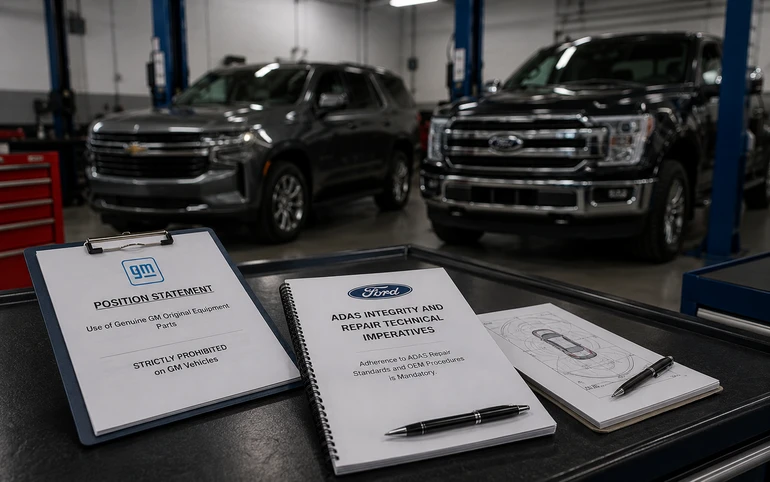
Two of the biggest names in your bays just moved the goalposts on ADAS repair. Across a series of refreshed position statements this year, General Motors and Ford/Lincoln have both tightened the language around how their advanced driver assistance systems must be repaired, and what parts you're allowed to put back on the car.
If you calibrate cameras and radar for a living, these documents now sit between you and a clean, defensible repair.
What GM Actually Said
GM didn't make one announcement here. It's been building a case throughout 2026, and the pattern tells you as much as any single line does.
Back in March, GM renamed its longstanding "Use of Salvage and Recycled Parts" bulletin to the Use of Genuine GM Original Equipment Parts position statement , which shifted the framing from what to avoid to what GM expects shops to install.
At that point, aftermarket and non-genuine parts in ADAS sensor areas were only "not recommended." By spring, that softer wording was gone, replaced with "not approved." Then over the summer, GM went further still: it revised its ADAS, aftermarket parts, bumper fascia, restraint system, and windshield statements to say those same parts are now "strictly prohibited."
Not Recommended
Aftermarket and non-Genuine parts in ADAS sensor areas.
Not Approved
GM removed the softer recommendation language.
Strictly Prohibited
Salvage, recycled/used and non-Genuine aftermarket parts.
Here's how it reads today. GM's position statement now states that the company "does not support and strictly prohibits the use of salvage, recycled/used, or non-Genuine aftermarket parts on Chevrolet, Buick, GMC, and Cadillac vehicles."
The logic behind it: GM doesn't design, engineer, test, or validate salvage, recycled, or aftermarket parts, so it can't confirm those parts meet its own safety, performance, or durability requirements.
On the ADAS side specifically, that means sensors, cameras, radar units, and control modules sourced from salvage, recycled, reconditioned, remanufactured, aftermarket, or any secondary-market supply are off the table.
Non-GM parts can put warranty coverage at risk when the damage, failure, or nonperformance is tied to those parts.
GM's position statement says damage, failure, or nonperformance tied to non-GM parts is not covered under the New Vehicle Limited Warranty or GM service plans .
GM's separate scanning statement, dated March 9, reaffirms pre- and post-repair scan requirements, and it adds that any work disrupting battery voltage or electrical circuits calls for a follow-up scan.
For a shop, that's not a theoretical risk. The radar unit you sourced used to save your customer a few hundred bucks is now, on paper, a part GM says shouldn't be on the car, and one an insurer or attorney could point to if a system underperforms down the road.
It's worth noting this isn't settled industry-wide either. The Automotive Recyclers Association has pushed back publicly on GM's stance, arguing that a properly inspected and calibrated recycled OEM component shouldn't be treated any differently than what's already on the car when it rolls in. That argument is still playing out. The position statement is what you're accountable to right now.
Ford and Lincoln Moved Too
Ford and Lincoln refreshed their own ADAS position statement this spring, and the update did more than restate what was already there.
New language states that Ford "officially mandates adherence to these standards," which closes the door on reading the document as a suggestion. You can pull the full Ford and Lincoln statements, titled "ADAS Integrity and Repair Technical Imperatives," through I-CAR's Repairability Technical Support portal.
Ford's position ties ADAS safety to repairing the vehicle according to its original design and service specifications.
The statement ties the safety of features like BlueCruise, Adaptive Cruise Control, and Pre-Collision Assist with Automatic Emergency Braking to one condition: the vehicle being equipped and repaired according to Ford's original design and service specifications.
In practice, that means a Ford or Lincoln with ADAS isn't considered repaired until it's back the way Ford built it, right down to the parts, the procedure, and the calibration.
Fall short, and Ford's position is that the system's safety performance can't be guaranteed. Recycled, salvaged, aftermarket, and reconditioned ADAS sensors are barred outright, and warranty coverage for ADAS-related components follows the same logic GM applies: use something else, and you're covering the fix yourself.
GM vs. Ford: What Changed?
The wording isn't identical, but the direction is clear: both OEMs are putting more weight behind OE parts, documented procedures, scanning, and calibration.
| AREA | GM | FORD / LINCOLN |
|---|---|---|
| ADAS Parts | Salvage, recycled/used and non-Genuine aftermarket parts are strictly prohibited. | Recycled, salvaged, aftermarket and reconditioned ADAS components are not accepted under the stated repair approach. |
| Repair Procedure | GM-approved procedures and OE parts are emphasized. | Ford officially mandates adherence to its repair standards. |
| Scanning | Pre- and post-repair scans are reaffirmed. | Diagnostic scanning is part of Ford/Lincoln's ADAS repair technical requirements. |
| Calibration | Follow the applicable GM procedure and calibrate to specification. | Calibration must follow Ford/Lincoln's original design and service specifications. |
| Warranty | Non-GM-related damage, failure or nonperformance may fall outside warranty coverage. | Improper parts or procedures can affect warranty or service-plan coverage. |
Mitchell's 2026 estimating data shows ADAS calibration appearing on 34.7% of repair estimates in 2025, up from 12.1% in 2022.
Why OEMs Are Drawing Harder Lines
More Cars Need Calibration
Mitchell's 2026 estimating data shows the share of repair estimates that include an ADAS calibration line item climbed 31.4% year over year in 2025, with calibration penetration more than doubling in three years to 34.7% of estimates in 2025, up from 12.1% in 2022. Read the Enlyte / Autobody News report.
AEB Is Becoming Standard
There's a federal piece too. NHTSA's FMVSS 127 rule requires automatic emergency braking as standard equipment on all new passenger vehicles and light trucks by September 1, 2029, with an extra year built in for small-volume manufacturers, final-stage manufacturers, and alterers.
The Stakes Are Getting Higher
More vehicles with cameras, radar, and forward-facing sensors means more exposure for automakers when those systems are repaired with parts or procedures they never validated. As AEB becomes standard equipment, whether a repaired sensor performs to specification increasingly becomes more than a customer-satisfaction question.
What It Means for Your Shop
Parts sourcing carries more risk now on both GM and Ford work. Reach for a recycled or aftermarket ADAS component to hit a price point, and you're handing an insurer or attorney a clean line to point to if anything goes wrong later. Documenting that you used OE sensors, and why, protects you as much as it protects the customer.
01. Follow the OEM Procedure
Both automakers now tie system safety directly to following published service information exactly as written: pulling the correct procedure for the specific vehicle, confirming which sensors need calibration based on the actual damage, and calibrating to specification with the right equipment.
02. Use the Correct Parts
"We've always done it this way" doesn't hold up when the OEM has spelled out the steps and, in Ford's case, called adherence mandatory. OE parts and documented sourcing give the shop a stronger position when the repair is reviewed later.
03. Keep Your Scan Reports
GM's reaffirmed position on pre- and post-repair scanning is a reminder that those reports are your evidence the job was done right. They belong in the repair file, not the trash.
Make the Repair Defensible
Use the correct OE parts, follow the OEM procedure, calibrate with the appropriate equipment, and keep the scan and calibration records with the repair file.
In-House Calibration Is Becoming More Valuable
None of this should worry a shop that's already set up to calibrate in-house. If anything, it's validation. You can point to the position statement, follow the procedure, install the correct part, and hand back a repair that holds up to scrutiny.
For shops still subletting calibration work or cutting corners, the distance between a compliant repair and a risky one just grew, and now it's in writing from the automaker itself.
Where This Leaves You
OEM position statements aren't law, but they carry real weight in insurance negotiations, liability disputes, and the standard of care your shop gets held to. With GM and Ford both tightening their language more than once this year, and with industry groups already arguing over where the line should sit, the smart move is to read the current documents, check that your parts and procedures line up, and hold onto the records that prove it.
The shops that treat these statements as a floor rather than a ceiling are the ones that won't get caught off guard the next time a revision lands.
Make Your Shop OEM-Ready
Want help making sure your calibration setup can meet OEM procedures across the makes you see most? ADAS Depot can help you spec the right tools and targets for the work coming through your door.
Sources
Ford, Lincoln, and GM Tighten ADAS Repair Standards in Refreshed Position Statements — Autobody News
GM Issues New Position Statement on ADAS, Parts and Warranty Implications — BodyShop Business
GM Strengthens OEM Parts Policy With Stricter Statements — GM Authority
General Motors Updates Position Statements — I-CAR RTS
Ford/Lincoln Position Statement: ADAS Integrity And Repair Technical Imperatives — I-CAR RTS
ARA Issues Statement on GM Position Regarding Recycled OEM ADAS Components — Automotive Recyclers Association
Enlyte's 2026 Trends Report Tracks Climbing Calibration Costs — Autobody News
FMVSS 127 Automatic Emergency Braking Final Rule — Federal Register
```
