
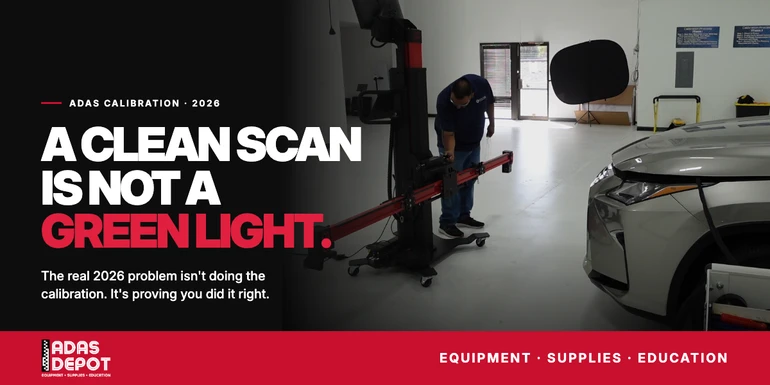
ADAS Calibration's Real 2026 Problem Isn't Doing the Work. It's Proving You Did It Right.
The challenge facing collision repair shops isn't simply whether a calibration gets performed. It's knowing which calibrations are required, making sure the vehicle is ready for them, and being able to prove the work was done correctly.
A sensor can be two degrees off center and still allow a vehicle to drive normally. The problem may not become obvious until an automatic emergency braking system hesitates, a lane departure warning behaves unexpectedly, or another ADAS function fails to respond when it is needed.
In 2026, the bigger issue for collision repair isn't just performing the calibration. It's identifying what the vehicle actually requires and proving that the work was completed correctly.
Identification: OEM Procedures Tell You How, Not Which
According to Repairify CEO Srisu Subrahmanyam, one of the first problems shops face is identification: knowing which sensors and systems need to be recalibrated based on the collision and the vehicle's systems.
OEM service information can tell a technician how to perform a calibration, but it doesn't necessarily tell the shop which calibrations a particular collision has triggered. That determination requires connecting the damage, the vehicle's systems, and the applicable OEM procedures.
Ryan DeMarco of All County Collision described a process that begins with a pre-scan and full disassembly, followed by identification software and then the exact OEM procedures. The important distinction is that software is treated as a starting point, not the final word.
John Melendez of JDM Collision & Calibrations makes a similar point. Fault codes alone do not determine whether a calibration is necessary. If a bracket, sensor, or camera has been impacted, the system may require testing or calibration even when no diagnostic trouble code is present. The final determination traces back to the OEM requirements.
Josh McFarlin, COO of AirPro Diagnostics, estimates that in roughly 40% to 50% of the cases where his team identifies a calibration requirement, the shop is hearing about that requirement for the first time. He says the number can be even higher for shops relying primarily on post-scan results.
The problem isn't necessarily that shops don't want to perform the work. The problem is that a calibration requirement can be missed before anyone reaches the calibration stage.
Third-Party Identification Tools Can Miss Required Systems
During a CIC exercise, co-chair Danny Gredinberg compared three calibration identification tools against the OEM requirements for a 2022 Ford Bronco. Two of the tools identified everything required, while the third missed blind spot radar and parking sensors.
That comparison illustrates why identification software should help narrow the field, but should not replace the OEM service information used to make the final determination.
Read more about the CIC calibration identification comparison →
Verification: A Clean Scan Is Not a Green Light
A blank screen and an absence of diagnostic trouble codes do not prove that an ADAS system is functioning correctly.
Subrahmanyam points out that a clean scan doesn't prove that radar sensors or cameras are aimed correctly or operating within the manufacturer's specifications.
DeMarco makes the distinction even more simply: the absence of a warning light does not mean the system is operating as designed.
Calibration should be the final verification of a properly repaired vehicle, not the way a shop discovers whether the vehicle was repaired correctly.
Melendez emphasizes the importance of verifying vehicle alignment, geometry, and mounting points before calibration. If the vehicle isn't properly repaired or positioned, a successful calibration procedure does not necessarily mean the underlying problem has been solved.
The Calibration Comes After the Repair Is Verified
A calibration procedure cannot compensate for incorrect geometry, damaged mounting points, or a repair that has not been completed to the required specifications.
The workflow therefore needs to happen in the right order: inspect the vehicle, verify the repair and alignment, identify the required systems, follow the applicable OEM procedure, and then verify the result.
Federal Policy Is Starting to Address ADAS Integrity
On May 21, 2026, the House Energy and Commerce Committee passed H.R. 7389, the Motor Vehicle Modernization Act. The legislation includes the ADAS Functionality and Integrity Act, reflecting growing federal attention to the safety implications of advanced driver assistance systems.
The legislation itself does not create a complete accountability system for every calibration performed after a collision. SCRS Executive Director Aaron Schulenburg has said the legislation raises awareness of vehicle changes that can affect systems such as automatic emergency braking and lane departure warning, while stopping short of mechanisms that would ensure every required calibration is performed.
Read the legislation:
The Liability Gap Is Real, and Subletting Doesn't Close It
Subrahmanyam estimates that approximately 65% of vehicles passing through collision repair shops require some form of calibration, while only around 35% to 40% of that work actually gets completed.
CIC and SCRS have also increased their focus on ADAS calibration. In April, Sean Carey noted that thousands of vehicles are entering the repair process either incorrectly calibrated or never calibrated at all.
23%+
CCC Intelligent Solutions reported that calibrations appeared on more than 23% of repairable appraisals in 2025, compared with less than 1% in 2017. The figure was nearly one-third of direct-repair claims, with an average calibration fee near $500 per vehicle.
The growth in calibration volume also makes responsibility more important. Subletting the work does not eliminate the shop's responsibility for the vehicle. Whether calibration is completed in-house, by a dealer, by a mobile provider, or through another remote service, the shop that accepted the vehicle still needs a process for identifying, verifying, and documenting the work.
What It Means for Your Shop
The most defensible approach is built around three habits:
Start with a pre-scan, inspect the vehicle during disassembly, use identification software to narrow the possibilities, and then confirm the applicable OEM procedure for the specific VIN. Software narrows the field. OEM information makes the determination.
Verify geometry, alignment, and mounting points before calibration. Perform the calibration according to the OEM procedure, then confirm system performance using the required testing and road test procedures where applicable. A clear scan is not the finish line.
Document the entire chain from identification through verification. As McFarlin puts it, shops need a process and need to follow it. A repeatable, recorded workflow provides an answer when someone later asks why a particular step was or was not performed.
Documentation Is Part of the Calibration
Documentation shouldn't be something created after the fact just to satisfy an insurance company or customer request. It should be part of the repair workflow itself.
The same discipline used to create an insurance-friendly calibration report can help a shop demonstrate that the vehicle was properly evaluated, that the required procedure was followed, and that the final result was verified.
If the process isn't documented, proving what happened later becomes much harder.
Where This Leaves You
Vehicle complexity is increasing. OEM position statements are becoming more specific. Regulators are paying more attention to ADAS functionality and integrity.
The shops building a sustainable calibration process aren't necessarily the ones with the most equipment. They're the ones with a repeatable workflow for identifying, verifying, and documenting the work.
That process protects the vehicle, the customer, and the shop. It also gives the shop a much stronger foundation when it comes time to explain and get paid for the work that was performed.
The Real Problem Isn't Calibration
The industry has spent years learning how to perform ADAS calibrations. The next challenge is making sure the right calibrations are identified, the vehicle is properly prepared, the results are verified, and every step can be demonstrated afterward.
In 2026, doing the work is only part of the job. Being able to prove you did the right work, on the right vehicle, according to the right procedure, is becoming just as important.
Building Your ADAS Calibration Workflow?
ADAS Depot can help you spec the right calibration targets, scan tools, and documentation solutions for your shop's workflow.
Visit ADAS DepotSources
- AutoBody News: ADAS Calibration in 2026: The Gap Between Getting It Done and Getting It Done Right
- CCC Intelligent Solutions: The Current State of Calibrations: A Turning Point for Collision Repair
- Congress.gov: H.R. 7389, Motor Vehicle Modernization Act
- Fleet Maintenance: House Committee on Energy and Commerce Passes Motor Vehicle Modernization Act
