
Most independent VW and Audi shops already own the VCDS diagnostic tool. The HEX cable lives in the laptop bag, it reads every fault the dealer scanner reads, and for a 2014 Golf it clears codes, resets service, and codes a new key. Then a 2023 Q7 comes in needing a dormant feature enabled, or a replacement module that throws a Software Version Management fault.
VW Group locked parts of the newer cars behind server-side security and software management that only its own tool talks to, and VCDS, for all it does, was never designed to reach them.
What VCDS Does Well
VCDS, short for VAG-COM Diagnostic System, is Ross-Tech's Windows software for the Volkswagen Auto Group. It covers VW, Audi, Seat, and Skoda from roughly 1996 through the current model year, and back to about 1990 with a 2x2 adapter. It connects through Ross-Tech's own interface, the wired HEX-V2 or the wireless HEX-NET, and on the cars and modules Ross-Tech has mapped it does most of what a dealer does day to day.
What It Handles Day to Day
On a car inside its coverage, VCDS covers the routine work:
- A full auto-scan of every module, with fault code read and clear
- Live data, output tests, and basic settings
- Coding and adaptations on mapped modules
- Throttle body re-adaptation and service interval resets
- Brake pad replacement mode and steering angle calibration on many platforms
- Key and immobilizer work
For a shop that does maintenance and repair on VW and Audi, a licensed VCDS scanner handles the bulk of the bay's daily diagnostic work without help.
How It's Licensed
VCDS comes in two license tiers. The enthusiast version is capped to a set number of vehicles, and the professional version is unlimited, which is the one a shop buys. Either way the license lives on the interface, so the cable is the tool.
Where the Coverage Stops
VCDS is reverse-engineered. Ross-Tech has mapped an enormous amount of the VW diagnostic protocol, but it is not the factory software, and three gaps show up the moment a job moves past diagnosis.
It Cannot Flash or Update a Module
VCDS does not flash firmware into a control module, and it does not perform Software Version Management, the server handshake VW uses to validate and update module software against the vehicle's build. Replace a module that expects an SVM check, or one that ships without current software, and the fault stays until an SVM-capable tool completes the handshake.
It Has No Guided Fault Finding
ODIS ships Guided Fault Finding, the manufacturer's test-plan workflow that walks a tech through a fault to its root. VCDS has no equivalent, so on an unfamiliar system the tech supplies the logic the factory tool would supply.
It Falls Short on Retrofits and New Platforms
Enabling factory options the hardware already supports, wireless CarPlay and ambient lighting among them, goes through ODIS engineering mode and an SVM handshake that validates the change against the server. VCDS long coding reaches only what Ross-Tech has mapped, and on the newest platforms that reach narrows. On MQB evo cars from about 2019 forward, some modules return little more than fault reads for anything past a scan.
The 2020-and-Newer Security Wall
The biggest change for VW and Audi shops arrived with SFD, the security system VW phased in on 2020 model year vehicles and expanded from there. SFD locks coding, adaptations, basic settings, and output tests on protected modules behind an online authorization. An auto-scan flags it: a module carrying SFD shows the tag on its identification line, and the functions behind it will not execute until the module is unlocked.
How Each Tool Handles SFD
- ODIS unlocks SFD online as part of the session, so the tech rarely sees it happen.
- VCDS can unlock SFD too, but not on its own. It uses Ross-Tech's SFD Unlock Service, a paid annual subscription tied to a single interface serial number and one verified person, with photo ID verification required because VW issues the authorization only to a verified user. The unlock is temporary and session based.
On 2024 vehicles VW added SFD2, which signs messages at the module level and blocks most retrofits outright. Neither VCDS nor ODIS can switch SFD off permanently. The difference is that one path is included and native, and the other is a separate subscription with an approval wait. This is the section that decides the tool for a lot of shops: a bay that started seeing 2021-and-newer VW and Audi work every week is the bay that hits SFD every week.
VCDS vs. ODIS at a Glance
|
Capability |
VCDS (Ross-Tech) |
ODIS (OEM) |
|
Coverage |
VW, Audi, Seat, Skoda, ~1996 to current |
Full VAG lineup, dealer-level |
|
Fault codes and live data |
Yes |
Yes |
|
Coding and adaptations |
Yes, within mapped modules |
Yes, full |
|
Guided Fault Finding |
No |
Yes |
|
Module flashing and SVM |
No |
Yes |
|
SFD security access |
Paid SFD unlock, session based |
Native, online |
|
Newest platforms (MQB evo, MEB) |
Narrows toward fault reads on some modules |
Full |
|
Retrofits and engineering mode |
No |
Yes |
Genuine, Cloned, or Shareware
Search for a cheap VCDS scanner and most of the results are clones. Ross-Tech's interfaces are copied heavily, and the copies carry the same problems a cloned OEM tool always does:
- A cloned HEX interface can be blocked. Ross-Tech identifies cloned and tampered interfaces and locks them out of software updates, which strands you on whatever version was loaded the day you bought it.
- The shareware route, a home-built cable with the free limited software, reads generic OBD-II data and little of the VW-specific depth that makes VCDS worth owning.
- Cloned VAS 6154 heads sold for ODIS are the worst trap for a shop, because a copy that fails the online security handshake partway through a flash can leave a module half-written.
What a VW and Audi Bay Uses Now
The setup that covers the whole fleet, old and new, is ODIS with a compliant interface. Four pieces:
The Software: Audi/VW ODIS Subscription
Audi/VW ODIS 1 Year Subscription, Installed, $2,300 per brand. ODIS is the VW Group's dealer software, and the subscription is sold by brand: Audi is $2,300 for the year, and VW is a separate $2,300, so a shop that works both covers the year at $4,600. Either subscription gives you dealer-level access to every module, Guided Fault Finding, coding and parameterization, module flashing, native SFD and security access, and the live data and service functions VCDS already does, in one tool that also finishes the jobs VCDS cannot. Our team registers it with Audi or VW and installs it remotely over TeamViewer rather than leaving you to fight the setup. Registration can take up to 14 days, so order ahead of the work.
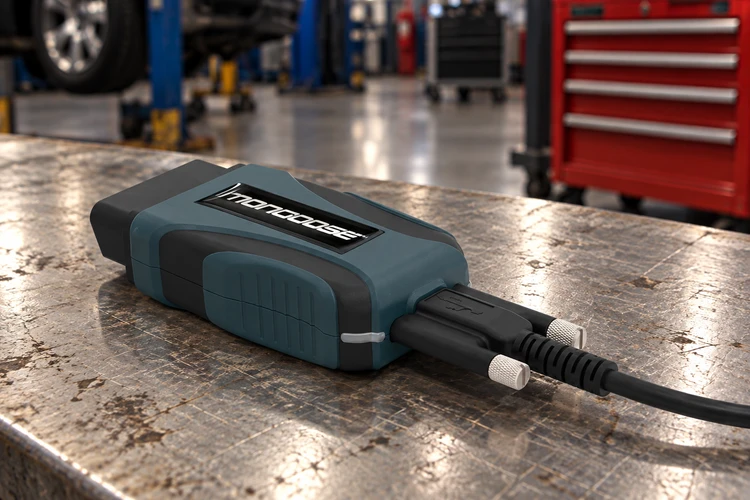
The Interface: Mongoose-Plus VW2
Opus IVS Mongoose-Plus VW2, $560.63, or the Bluetooth Mongoose-Plus VW2-BT, $765.38. ODIS needs the factory VAS 6154A head or a compliant J2534 pass-thru device to reach the car. The Mongoose-Plus VW2 is that compliant device, made for ODIS, with full diagnostics and reprogramming on 2004-and-newer VW and Audi and CAN-FD support for the current cars. It costs a fraction of the factory head. Use the wired version for programming.
The Programming Power Supply
A flash can take twenty minutes or longer, and system voltage has to hold the whole time. A battery maintainer made for programming at $389 holds a flat line under load where a shop charger does not, and it costs far less than a module bricked by a voltage sag mid-write.
The Laptop
You supply a Windows 10 or 11 laptop. If building one for OEM software is not how you want to spend an afternoon, we assemble diagnostic laptops set up for the job. For the wider case on subscription cost against aftermarket coverage, why OEM scan tools are the standard does the math, and if you are still sorting out the pass-thru side, J2534 pass-thru programming tools covers the hardware standard.
Coding and Programming Are Not the Same Job
- Coding tells a module which options the car has and changes configuration in software already on it. VCDS codes.
- Programming, or flashing, writes new software onto the module, and on VW Group cars it travels with an SVM handshake to the factory server. VCDS does not program.
A new part often needs both coding and programming, in that order, which is the exact place a VCDS-only bay stalls: the coding goes in, the software update does not, and the fault stays lit.
Where ADAS Comes In
Driver assistance sits on the far side of this line by design. Front camera, radar, and lane systems on VW and Audi calibrate through ODIS guided procedures, and on 2020-and-newer cars the module often sits behind SFD, so unlocking the security access is part of the same job. VCDS reads the ADAS faults and the sensor data, useful for working out why a calibration failed, but the calibration itself belongs to the factory workflow. Static camera and radar calibrations are performed against the correct VW and Audi calibration targets; dynamic ones need a road drive.
The triggers are the same as on any make. A camera or radar calibration comes from:
- Windshield replacement
- Sensor removal or disturbance
- An alignment or ride height change
- Collision damage
This is separate from the coding and programming above. Check the VW or Audi position statement for the platform in front of you, because a miscalibrated sensor logs no code and still leaves the system doing the wrong thing.
Sorting Out Your VW and Audi Setup
Our team programs VW and Audi vehicles every day and can tell you whether ODIS and a Mongoose interface covers what comes through your door, with the software installed before the tool ships. For the brand-by-brand hardware and subscription breakdown, see our OEM Software and Hardware Guide. Book a free consultation or call (925) 566-8545.
