
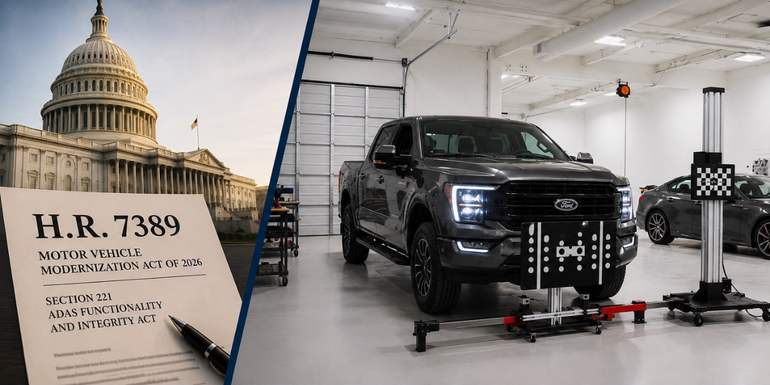
A bill that could fundamentally change how the industry thinks about ADAS calibration just took a major step forward. On May 21, 2026, the House Committee on Energy and Commerce passed H.R. 7389, the Motor Vehicle Modernization Act of 2026. Section 221 of that bill is the ADAS Functionality and Integrity Act, a bipartisan measure backed by SEMA that's been in the works since late 2025 and is now heading to a full vote on the House floor.
For shops doing ADAS calibration work, this is worth paying attention to. Here's what the bill actually says and why it matters.
Background: Where This Bill Came From
The ADAS Functionality and Integrity Act was originally introduced as a standalone bill (H.R. 6688) in December 2025 by Rep. Diana Harshbarger (R-TN), with bipartisan co-sponsors including Rep. Gabe Vasquez (D-NM), Rep. Jay Obernolte (R-CA), Rep. Norma Torres (D-CA), and Rep. Ryan Mackenzie (R-PA). It was later incorporated into the broader Motor Vehicle Modernization Act as it moved through committee.
The motivation behind it is straightforward: as ADAS systems become more common, and increasingly mandatory, there's been no federal framework defining what happens to those systems when a vehicle gets modified. No published tolerances, no official recalibration triggers, no standardized test procedures. Shops have been left to rely on OEM service information when it's available, and guesswork when it isn't.
SEMA, which has been conducting its own research on this for years, pushed hard for the legislation. The organization has published a series of white papers examining how aftermarket modifications affect ADAS performance on popular platforms like the Chevrolet Silverado 1500, Ford F-150, Ford Bronco, Toyota Tacoma, and Ram 1500, covering how lift kits, wheel changes, and suspension modifications influence sensor reliability and when recalibration becomes necessary. That research forms part of the data foundation the bill is designed to build on.
What the Bill Actually Requires
Section 221 of H.R. 7389 has two main phases.
Phase 1 — The study. NHTSA has 18 months from enactment to complete a study on the ten most common vehicle modifications and their impact on ADAS functionality. That includes things most shops see regularly: lift kits, larger wheels and tires, aftermarket bumpers with winches, wraps, and bike racks. The agency must publish the findings on its website.
Phase 2 — The guidelines. If NHTSA determines it's feasible and practical, it then has two additional years to issue actual guidelines: defined modification ranges and tolerances for new vehicles, calibration procedures shops should follow after modifications, and ADAS test procedures that aftermarket businesses can use to validate that systems have been properly calibrated after work is done. The guidelines would apply to model year 2028 and later vehicles. PM
The bill also includes an important transparency provision: automakers would be required to share key information about ADAS tolerances and system sensitivities with both vehicle owners and NHTSA within 30 days of releasing a new model. And it establishes a working group — including representation from disability and elderly advocacy organizations, among others — to inform the process.
Why the Timing Matters
NHTSA's FMVSS 127 rule requires automatic emergency braking (AEB), along with pedestrian AEB and forward collision warning, to be standard equipment on all new passenger cars and light trucks by September 2029. NHTSA estimates the rule will save at least 360 lives and prevent more than 24,000 injuries per year. (The rule has faced some regulatory uncertainty under the current administration, but the September 2029 deadline remains on the books.)
What that means in practice: within a few years, essentially every vehicle that comes into a shop for a lift kit, a bumper swap, or even a set of larger tires will have a federally mandated safety system that could be affected by that work. The ADAS Functionality and Integrity Act is designed to make sure shops, and customers, have the information they need to handle that responsibly.
As SEMA's VP of OEM and Product Development Jim Moore put it when the bill was introduced: "Calibration is essential for safety and reliability when you need it most."
What It Means for Your Shop
For shops already equipped to do ADAS calibration, this bill reinforces what you're already doing. The research phase will produce publicly available data on exactly which modifications require recalibration on which platforms, useful information whether or not the guidelines phase ever produces formal rules.
For shops that haven't yet invested in calibration equipment, the direction of travel is clear. A federal rulemaking process is now underway that will, in all likelihood, define recalibration as a required step after common modifications on vehicles going back to MY 2028. Shops without the tools to do that work will either need to acquire them or refer that business elsewhere.
The bill still needs to pass the full House and clear the Senate before it becomes law. But clearing committees with bipartisan support, and being folded into a larger vehicle safety bill, is a meaningful sign of momentum. It's worth tracking.
Have questions about ADAS calibration equipment for your shop? Contact us, we're here to help.
