
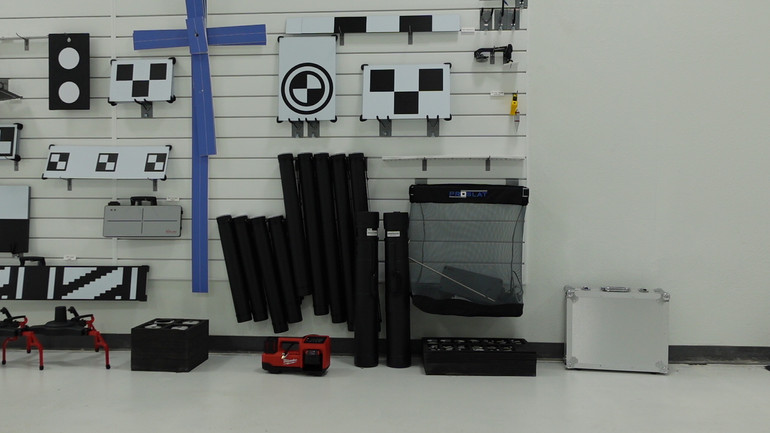
Most Common Questions in ADAS (And Answers)
ADAS calibration requirements remain one of the most misunderstood areas in modern vehicle repair. Here are answers to some of the most common questions shops ask about calibration, setup, targets, scan tools, and documentation.
Advanced Driver Assistance Systems (ADAS) are now present on nearly every late-model vehicle, yet calibration requirements remain one of the most misunderstood areas.
At ADAS Depot, we regularly work with shops that are either entering the ADAS space or refining existing calibration workflows. These questions reflect the most common technical and procedural issues we get asked in real-world shop environments.
When Is a Calibration Required?
Almost any repair that disturbs an ADAS sensor or its mounting location requires calibration, as defined by OEM service information.
Windshield Cameras
- Windshield replacement
- Camera bracket replacement
- Camera removal and installation
- Dash removal
- Airbag deployment
- Roof repairs on some OEMs
Front Radar
- Bumper removal
- Grille replacement
- Radar bracket replacement
- Collision damage, even light damage
- Alignment that significantly changes thrust angle
- Ride height changes
Blind Spot Radars
- Rear bumper removal
- Corner repairs
- Quarter panel replacement
- Inner bumper support changes
- Wheel offsets or ride height changes on some models
Surround View / Bird's-Eye Cameras
- Mirror replacement
- Door removal
- Trunk lid removal
- Front or rear camera changes
- Wheel or tire size changes
Parking Sensors
- Sensor replacement
- Bumper cover replacement
- Bracket adjustment
If the OEM mentions calibration in the FSM, you must do it. If the system uses a camera or radar, calibration is typically required.
Why Won't My Calibration Complete?
A common refrain in the industry is that calibration is the final 5% of the job, but it requires 100% of the prep work. The vast majority of calibration failures boil down to preconditions not being met.
Common contributing factors include:
- Floor slope greater than 1°
- Vehicle not at the correct ride height
- Alignment out of specification
- Steering angle sensor not initialized
- Poor lighting or shadows on camera targets
- Target placed at the wrong distance
- Crooked calibration frame
- Uneven tire pressure
- Vehicle not loaded according to OEM requirements
For Radar
- Radar bracket bent a few millimeters
- Aftermarket or repainted fascia blocking radar
- Radar tilted vertically because the bumper is not clipped properly
For Dynamic Calibrations
- Poor lane markings
- Heavy traffic
- Speed requirement not met
The majority of calibration failures are caused by physical setup issues rather than scan tool limitations.
Do I Need a Perfectly Level Floor?
Mostly yes, but what qualifies as level depends on the OEM.
| OEM | Floor Requirement |
|---|---|
| Honda | < 1° slope; ideally < 0.5° |
| Toyota | "Level surface," practically < 0.5° |
| Subaru | Very sensitive, < 0.5° advised |
| Hyundai / Kia | Often allow slight slope; Autel compensates, OEM does not |
| VW / Audi | Strict; < 0.5° |
| GM | Less sensitive but still requires < 1° |
Can Aftermarket Systems Compensate?
- Autel: Uses laser leveling and software compensation, but still needs a reasonably flat floor.
- Topdon & Launch: Some compensation, though less sophisticated.
- OEM targets: Almost always require the surface itself to be level.
Can you shim the vehicle? Technically yes, but never recommended unless the OEM explicitly allows it. You are changing the suspension geometry, meaning the vehicle is no longer sitting at its natural curb height.
Is a Post-Scan + Test Drive Enough?
No. A system that appears to work can still be misaligned by several degrees, enough to cause lane departure inputs too early or too late, ACC following distance errors, or blind spot false negatives.
Functionality does not mean accuracy.
Only an OEM-approved calibration resets the sensor to known geometry.
Why Do OEM Service Instructions Contradict My Aftermarket Scan Tool?
There are several common reasons for differences between OEM service information and aftermarket scan tool procedures.
1. The OEM Updated Its Procedures
Aftermarket software may not have caught up yet. Autel is usually fast, but some models can still lag several months behind OEM updates.
2. The Aftermarket Tool Adds a Static Calibration
Some tools add a static calibration even when the OEM procedure uses dynamic calibration only, sometimes to cover variations across global markets.
3. The Procedure May Be Mislabelled
Some aftermarket menus can label a procedure as "Static + Dynamic" when the static step simply verifies sensor initialization.
Always follow OEM instructions over the scan tool.
How Accurate Does Target Placement Need to Be?
Modern ADAS targets are extremely sensitive, especially for camera-based systems.
Typical tolerances:
- ±2 mm target center
- ±1 mm on height
- ±0.5° yaw / pitch
- ±3 mm front-to-back distance
- ±2 mm left/right offset
Even being 5 mm off can cause pulling during lane keep, early or late lane departure warnings, poor road sign detection, or reduced ACC distance accuracy.
For camera-based procedures, laser measurement is preferred.
What's the Correct Test Drive Procedure?
Requirements vary by OEM, but dynamic calibrations typically depend on the right combination of speed, lane markings, traffic, and duration.
Speed
- 25–45 mph minimum
- Some require more than 55 mph, including certain Subaru and Mazda radar procedures
- Toyota often needs several miles at more than 35 mph
Lane Markings
- Clean, continuous white or yellow lines
- No construction zones
- No heavy shadows
- No rain or low-sun glare
Traffic
- Light to moderate traffic
- Enough vehicles for ACC to lock onto
Duration
Typically 5–20 minutes depending on the system. Some procedures require two separate conditions, such as a straight road followed by curves.
If lane lines are poor, the dynamic calibration may never complete.
Can Aftermarket Scan Tools Be Trusted for ADAS?
Yes, but "aftermarket" covers a wide range of tools, and the right one depends on the vehicles you service and how your shop works. Whatever you choose, OEM service information always has the final word on the procedure.
Autel offers wide vehicle coverage, follows OEM procedures closely, and is widely used in calibration-focused shops.
Launch builds its calibration systems to mirror OEM setups, including OEM-sized targets.
Topdon and XTool are convenient, good-value options that can work well as a second system or for lighter-duty work.
Texa is excellent for European vehicles and follows OEM-style processes, though it has limited US penetration.
General rule: Choose based on the makes you work on, the OEM procedures the tool supports, and the targets and space you have. Ask for a demo on a vehicle you actually service.
Does Ride Height Really Matter?
Yes, dramatically.
Even a 1/4-inch difference at the suspension can tilt the radar several degrees, change camera pitch, or move blind spot sensors off axis.
Examples
- Honda: If ride height is out of specification, radar cannot be calibrated.
- Toyota: Camera calibration can pass while lane keep still pulls.
- Subaru: Extremely sensitive to pitch angle.
- GM trucks: Lifts can require radar bracket shimming or new brackets.
If the vehicle is lowered or lifted, the change needs to be documented, and OEM calibration may not succeed.
Am I Liable If I Skip a Required Calibration?
Yes.
Shops may be exposed to liability depending on jurisdiction and circumstances when a required calibration is skipped and a safety failure occurs.
Best practices include:
- Provide the customer with a written statement
- Get a signature if the customer refuses calibration
- Document scan results
- Store before-and-after images of the target setup
ADAS is a safety-critical system, so documentation is an important part of the calibration process.
Why Do OEMs Require Expensive Targets When Aftermarket Works?
OEM targets can require exact specifications that go beyond simply reproducing a printed pattern.
- Exact reflectivity of printed patterns
- Exact distortion control
- Exact pixel dimensions
- Exact contrast ratio
- Aftermarket prints can warp over time
- Aftermarket targets may not match regional variations
Autel's algorithm can compensate for some imperfections, but OEM procedures do not allow that compensation.
How Do I Verify a Calibration Actually Worked?
A successful calibration should be verified and documented rather than simply assumed because the system appears to function normally.
1. Confirm No DTCs
Check before and after the calibration.
2. Verify Sensor Alignment Values
Many OEMs show values such as:
- Horizontal angle
- Vertical angle
- Yaw / pitch misalignment
- Camera focal calibration score
3. Road Test
- Lane keep
- Lane departure
- ACC following distances
- Blind spot performance
- Sign recognition, if equipped
4. Documentation
- Screenshots
- Measurement photos
- Final printed calibration report
- Pre- and post-scan documentation
5. Customer Demonstration
Some shops are starting to demonstrate the system to customers to help avoid false claims.
Can I Calibrate Outside? What About Sunlight?
Static Calibrations
Usually no.
- Sun glare on cameras
- Shadows distorting target contrast
- Wind moving boards
- Uneven ground
- Reflective surfaces confusing radar
If you must calibrate outside:
- Use shade
- Avoid direct midday sun
- Ensure perfectly flat concrete
- Avoid changing light conditions
Dynamic Calibrations
Outside is required, but the conditions still matter.
- Clear lane lines
- Avoid low sun angles
- Avoid nighttime unless the OEM allows it
The Bottom Line
ADAS calibration is rarely just a matter of connecting a scan tool and following the prompts. Vehicle preparation, floor conditions, ride height, target placement, OEM procedures, and documentation all play a role in getting the job done correctly.
The most important rule is simple: OEM service information should always take precedence over scan tool prompts.
We hope these FAQs set you on the right path for ADAS calibrations. If you have questions about calibration equipment, targets, scan tools, or setting up your shop, ADAS Depot is here to help.
The right equipment and the right procedure go hand in hand. Follow OEM service information and build your calibration workflow around accurate setup and documentation.
Ready to Build Your ADAS Workflow?
Explore ADAS calibration equipment, targets, scan tools, and shop solutions from ADAS Depot.
Explore ADAS Equipment →ADAS DEPOT | EQUIPMENT · SUPPLIES · EDUCATION
