
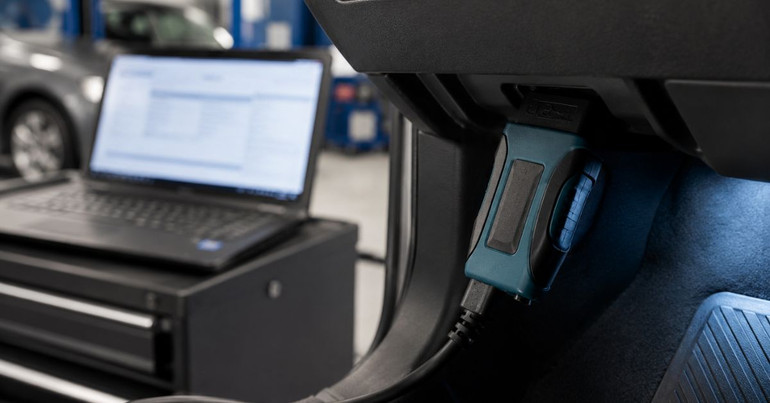
Sooner or later, every shop hits the same wall. A scan tool reads the codes, points you at a module, and then the repair calls for a software update or a brand-new control unit that ships empty. That last step, flashing the module, is where a J2534 device earns its spot on the bench. Whether you run a busy collision shop or you're a DIYer trying to program your own PCM at home, understanding J2534 hardware saves you money and headaches.
This guide covers what a J2534 pass-through device does, what you need around it to flash a module, and how to pick a J2534 programmer or cable that will still work on next year's vehicles.
What is J2534?
J2534 is an SAE standard that lets factory reprogramming software talk to a vehicle through one piece of hardware instead of a separate dealer tool for every brand. It exists because the EPA and CARB told automakers to make emissions-related module programming available to independent shops. J2534-1 covers that emissions side. J2534-2 widens the door to other modules like body, chassis, and infotainment.
In plain terms: the standard is what makes a single J2534 tool useful across Ford, GM, Stellantis, Toyota, and the rest, as long as each automaker validates the device.
How a J2534 Pass-Through Device Works
A J2534 pass-through device sits between three things: a Windows laptop, the automaker's software, and the vehicle's OBD-II port. You download the OEM application from that brand's service website, download your specific J2534 drivers in your laptop, plug the device into the car, connect it to your PC over USB or wireless, and the OEM software pushes the new calibration through the device and into the module.
Three points trip people up:
- It's Windows only. The OEM apps don't run on a Mac, so plan on a dedicated Windows laptop.
- You still pay the automaker. The hardware is yours, but the software runs on a subscription, often priced by the day, month, or year per brand.
- Many late-model vehicles sit behind a security gateway. Stellantis (AutoAuth), GM, and others want you registered and authenticated before the module will accept a flash.
What You Need to Flash a Module
The device is one part of a working setup. To program a module start to finish, plan on:
- A J2534 pass-thru tool with current protocol support
- A Windows laptop with a stable internet connection
- An OEM software subscription for the brand you're working on
- A battery maintainer or power supply that holds voltage steady through the flash
That last one matters more than newcomers expect. A flash can run 20 minutes or longer, and if system voltage sags partway through, you can brick a module that costs thousands to replace. A clean power supply is cheap insurance. ADAS Depot's battery management gear is built for this job.
J2534 Programmer vs. Scan Tool vs. OEM Tool
A scan tool reads and clears codes and runs tests. A J2534 programmer does the reflashing. Some tablets do both, which is where the lines blur.
An OEM tool is the dealer's branded box, locked to one make. A J2534 programmer is the open route: one device, many brands. For a shop that touches more than one nameplate, a single J2534 tool replaces a shelf full of factory boxes and the cost that comes with them.
What to Look for in a J2534 Tool
Not every J2534 tool is built for the cars rolling in today. Before you buy, check these:
- CAN FD and DoIP support. Newer vehicles use these protocols. A device without them will leave you stuck on late-model work.
- OEM validation. Each automaker publishes a list of approved pass-thru devices for its software. Confirm the device you want is on the lists for the brands you service.
- Speed and stability. Faster, cleaner data transfer means shorter flashes and fewer failed updates.
- Support behind it. When a flash stalls at 60 percent, a phone number that picks up is worth a lot.
J2534 Cable vs. Full Programmer
Shoppers searching for a J2534 cable usually mean one of two things.
A single-brand J2534 cable, like the Opus IVS Mongoose line, is a lower-cost way into one automaker's programming. It's a smart pick if most of your work lives under one badge.
A full multi-protocol unit, like the Opus IVS CarDAQ or the Autel MaxiFlash family, handles a wide spread of makes plus the newer protocols. It costs more up front and pays for itself across a mixed bay of vehicles.
If you're unsure which side you fall on, count the badges that come through your door in a typical month. That number usually answers the question.
J2534 Tools We Recommend at ADAS Depot
A few proven picks from our VCI / J2534 / OEM hardware lineup:
- Autel MaxiFLASH XLINK: a 3-in-1 unit that works as a VCI, a J2534 pass-thru programmer, and a Remote Expert-ready device. A strong choice if you want one box that grows with you.
- Autel MaxiFlash Elite / MF2534: the workhorse J2534 programmer that's flashed modules in shops for years.
- Opus IVS CarDAQ: the multi-protocol favorite, with remote programming help on tap when a job goes sideways.
- Opus IVS Mongoose: the budget-friendly single-brand cable for shops that mostly stay in one lane.
Not sure which fits your bay? Our team programs vehicles every day and can match you to the right device. Book a free consultation or call (925) 566-8545.
J2534 FAQ
Do I need a subscription to use a J2534 tool? Yes. The device is a one-time purchase, but the OEM software that does the flashing runs on a paid subscription from each automaker.
Can I use a J2534 programmer on any car? Mostly, within limits. The device has to support the right protocols, and the automaker has to validate it for their software. Check the brand's approved tool list first.
Will a J2534 cable work for ECU programming? A single-brand J2534 cable can flash modules for the make it supports. For multiple brands and newer protocols like CAN FD and DoIP, a full programmer is the better buy.
What happens if power drops during a flash? You risk corrupting the module. Use a battery maintainer rated to hold voltage through a long programming session.
