
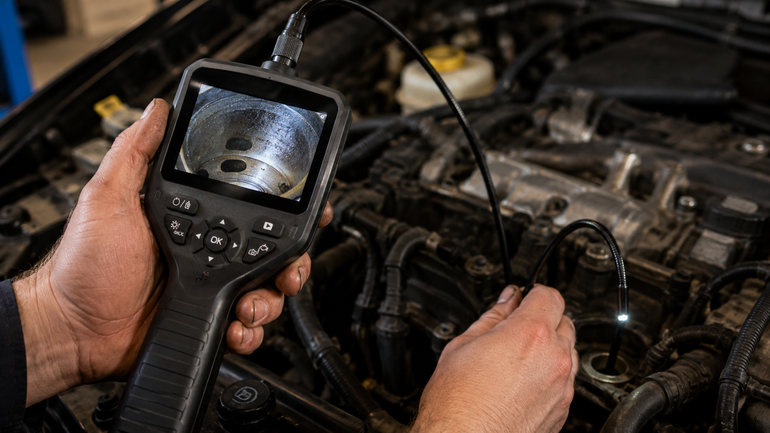
A flashlight and a mirror only get you so far. The moment a tech needs to look inside a cylinder, behind a timing cover, down an intake runner, or into a door cavity, an inspection camera turns a guessing game into a clear picture. For a working shop, the right borescope cuts diagnostic time, shows customers the problem they can't see for themselves, and backs up a repair recommendation with recorded video. Below is how to choose one, plus the automotive inspection cameras ADAS Depot carries at every budget.
What an Inspection Camera Does in the Bay
An inspection camera (also called a borescope or video endoscope) is a small camera on a flexible cable that feeds video to a screen. In day-to-day shop work, it earns its place on jobs like these:
- Checking cylinder walls and piston tops through the spark plug hole before tearing an engine down.
- Spotting carbon buildup on intake valves or inside the manifold.
- Tracing wiring, connectors, and modules behind the dash or inside door cavities.
- Finding fluid leaks, rust, or rodent damage in spots no hand or eye can reach.
- Documenting pre-existing damage with a photo or clip saved straight to the repair order.
That last point matters for collision and calibration shops too. When you're pulling bumpers and trim to reach radar and camera sensors, a quick borescope shot records the condition of hidden brackets and harnesses before you ever touch them.
Seatbelt and SRS Airbag Inspections
After a collision, the restraint system on many vehicles today needs to be checked before the car goes back on the road. Seatbelt pretensioners, airbag modules, the clockspring, impact sensors, airbag and seatbelt mounting points, and the wiring that ties them together usually sit behind trim panels, body panels, and seats. Pulling all of that apart to eyeball each item can eat up three hours on a single car.
A borescope changes the math. Feed the camera behind a panel, under a seat, or up into the dash, and you can inspect a pretensioner, impact sensor, SRS mounting points, or an airbag connector right where it sits, then capture a photo of what you find. That can take the same job from about three hours down to one, and you walk away with the images an insurer wants to see before releasing payment on the claim. For a collision or calibration shop, that means faster turnaround and cleaner documentation on the work that has to be right.
Borescope, Videoscope, or Endoscope: What's the Difference?
You'll see all three terms used for the same kind of tool, and the lines between them have blurred. A borescope originally meant a rigid optical tube; today "auto borescope" gets applied to almost any cable-and-camera unit. A videoscope sends its picture to a digital display. An endoscope borrows the medical name for the same flexible-camera idea. In a shop setting they're interchangeable, so don't get hung up on the label. What separates a good automotive borescope from a frustrating one comes down to the hardware below.
What to Look For in an Automotive Borescope
A few things decide whether a tool stays in the drawer or gets used every week:
- Camera head diameter. Thinner heads around 5.5mm slip through spark-plug holes and tight ports. Larger heads near 8.5mm trade some access for a bigger lens and more light.
- Cable length and stiffness. A semi-rigid cable holds its shape so you can steer it around corners and have it stay put.
- Tip articulation. A camera tip that bends on command lets you aim the lens around a corner instead of twisting the whole cable and hoping.
- Resolution and lighting. A high-resolution head with adjustable LED brightness gives you a usable image in a dark cavity instead of a grainy blur.
- Display type. Some units have a built-in screen, others connect to your phone, PC, or diagnostic tablet. Each has a place depending on how your shop already works.
- Photo and video capture. Recording is what turns the camera from a flashlight into a documentation tool you can attach to the RO.
Inspection Cameras That Pair With Your Scan Tool
If your bays already run Autel tablets, the simplest path is a camera head that plugs into the tool you carry every day. The Autel MaxiVideo MV108S uses an 8.5mm, 2-megapixel head and runs through the MaxiVideo app on Autel diagnostic tablets, so the footage lands alongside the rest of the job with no second screen to manage. Need to reach tighter spots like spark-plug holes? The MaxiVideo MV105S drops to a 5.5mm head with its own LED lighting.
Both are a natural add-on if you're already shopping the diagnostic scan tools lineup, and they're the most affordable way into a quality automotive inspection camera.
On the entry end, the Launch VSP-600 USB video scope is a light, easy-to-handle option with a 32-inch flexible probe and a 5.5mm camera head rated IP67 against fluids, so it holds up in wet or dirty cavities. Adjustable LEDs light the view, and it captures live video and stills at VGA resolution for documentation. For shops already running a Launch X-431 scan tool, it plugs right into the tablet and works with it, which makes it an easy add-on instead of one more separate screen. It also runs off a laptop over USB.
Standalone Videoscopes for Everyday Shop Work
Prefer a self-contained tool that doesn't tie up your scanner? ADAS Depot stocks a full range of standalone units in the videoscopes category.
Want a built-in screen ? The Launch VSP-800 with a 2.7-inch display or the 4.3-inch version give you a self-contained handheld with a larger view.
Thinkcar's endoscope line leans on the feature that makes tight inspections far easier: 180-degree bidirectional articulation. Instead of twisting the whole cable and hoping the lens lands where you want, you steer the camera tip itself up to 180 degrees in either direction, so you can look around a corner, off to the side of a bore, or back toward where you came from. The Thinkcar TES 303 Pro brings that bidirectional control in a 6.5mm probe with a 1280x720 feed and six onboard LEDs, at the most affordable point in the line. The TES 402 keeps the same 180-degree steering and adds an HD display for a sharper picture. At the top, the TES 205 steps up to a built-in LCD for techs who want a premium, self-contained camera.
For Autel users who want a standalone option, the MaxiVideo MV460 is a digital videoscope with a 39.4-inch semi-rigid cable, a 70-degree field of view, 10-level LED lighting, and a 2-megapixel camera. The MaxiVideo MV480 adds a second camera so you can capture a forward and side view at the same time.
Which Inspection Camera Is Right for Your Shop?
A quick way to narrow it down:
- You already run Autel tablets: the MaxiVideo MV108S (8.5mm) or MV105S (5.5mm, for tighter ports) keeps everything on one screen.
- You run a Launch X-431: the VSP-600 plugs straight into it.
- You want a self-contained tool with its own display: the Launch VSP-800, Thinkcar TES 402 or TES 205, or Autel MV460.
- You need to steer around corners and tight bends: the Thinkcar TES 303 Pro or TES 402, with 180-degree bidirectional tip control.
- You need to see two directions at once: the dual-camera Autel MV480.
- You're on a tight budget or only reach for it occasionally: the Launch VSP-600 or the Autel MV108S.
Whatever fits your bays, an inspection camera pays for itself the first time it saves a teardown or closes a sale with video the customer can see. Browse the full inspection camera and videoscope lineup, or reach out to the ADAS Depot team if you want a recommendation for the work coming through your shop.
