
If you run a collision, glass, or calibration shop, you already know that getting paid for ADAS work is half the battle. Identifying what calibrations a vehicle needs after a repair is one thing — documenting it in a way that satisfies an insurance company is another. That is where estimate scrubbing software comes in.
These platforms analyze a repair estimate and generate a report that identifies required ADAS calibrations, supports each line item with OEM documentation, and gives your shop the paper trail it needs to get reimbursed. The promise is compelling: less time arguing with adjusters, fewer denied claims, and a more defensible repair file.
But how well do these tools actually deliver on that promise? We put five of the leading platforms through a structured evaluation using five real-world CCC ONE estimates, a 2024 Ford F-150, a 2024 Hyundai Elantra, a 2024 Mitsubishi Outlander, a 2026 Nissan Sentra, and a 2026 VW Atlas, to find out.
What We Tested and Why It Matters
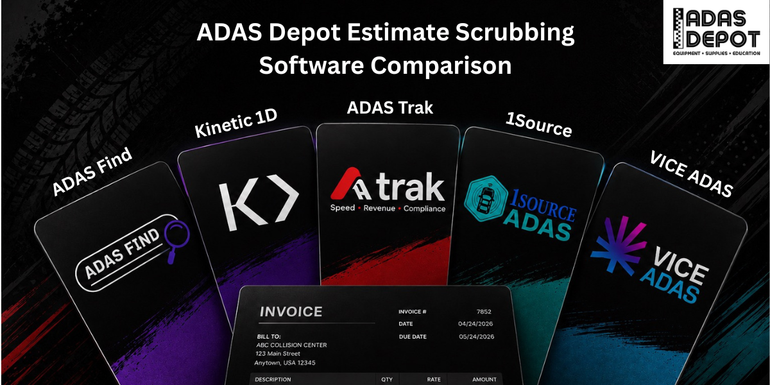
The five platforms included in this comparison are 1Source ADAS, ADAS Find, Kinetic ID, ADAS Trak, and Vice ADAS. Revv declined to participate.
For each vehicle, we asked each platform to identify required calibrations, provide supporting OEM documentation links, and flag pre- and post-scan requirements. We then graded the results across four dimensions:
Calibration identification. Did the platform correctly identify what calibrations are required? Missing a required calibration is the worst outcome, it creates a safety risk and leaves revenue on the table. But over-identifying calibrations (false positives) creates its own problem: insurance pushback that slows down your cycle time.
Link accuracy. Did the OEM documentation links actually work and go to the right document? A link that leads to a generic manufacturer homepage, or worse, to the wrong vehicle entirely, does not help you justify a line item to an insurer. We tested every single link.
Conditional and recommended calibrations. Some calibrations are required only under specific conditions (for example, if rear alignment angles were adjusted). Others are recommended by the OEM but not strictly required. Did the platform distinguish between these categories?
Pre- and post-scan coverage. Did the platform include documentation supporting pre- and post-scan requirements? This varies significantly by make, Nissan and Hyundai recommend pre-scans but require post-scans, while Audi and VW do not publish statements requiring either.
Safety and seatbelt inspections: Does your facility currently perform the safety and seatbelt inspections required by many manufacturers following a vehicle collision. These essential procedures are often identified by various diagnostic platforms. Incorporating these required inspections into your workflow ensures vehicle safety compliance and provides an opportunity for additional revenue.
Platform Summaries
1Source ADAS
1Source turned in a strong performance across the board. The platform correctly identified calibration requirements across all five test vehicles and organized vehicle options clearly, making it easy to understand why each line item was flagged. Pre- and post-scan documentation was included and accurate.
Link quality was generally reliable. For the Volkswagen test vehicle, the erWin documentation links require valid Volkswagen credentials due to licensing restrictions. Because this particular model did not have service information available through ALLDATA, none of the platforms were able to display the underlying OEM documentation for comparison.
The one gap in 1Source's feature set is the absence of integrated invoicing. Shops that want an all-in-one platform will need to use a separate system for that part of the workflow. That said, the team's responsiveness and commitment to accuracy were noted as genuine strengths.
Pricing is tier based, per report pricing that is volume based.
Strengths: Accurate calibration identification, clear organization, reliable links, strong pre/post-scan documentation, flexible pricing.
Limitations: No integrated invoicing; VW OEM links require manual navigation.
ADAS Find
ADAS Find offers a clear layout and performed well on calibration identification across the test vehicles. Vehicle equipment options are organized in a way that makes the report easy to follow, and the OEM links we tested were generally of good quality.
The platform stands out for its integrated invoicing system, which is customizable and covers the full workflow from identification to billing. It also integrates with CCC1 and Audatex on the Standard tier, and adds QuickBooks integration on the Essentials tier, useful for shops that want their calibration reports to feed directly into their accounting system.
Pricing is tiered: Standard at $359/month (60 reports), Essentials at $499/month (75 reports), and Pro at $599/month with full shop management and AI integrations. A 7-day free trial is available on all tiers.
Strengths: Clean layout, reliable links, integrated invoicing, strong software integrations.
Limitations: Higher price point than some competitors; report volume is capped by tier.
Kinetic ID
Kinetic ID is the most accessible entry point in this comparison. The software is free for up to 1,000 VIN lookups per year, which makes it a low-risk option for shops that want to start using scrubbing tools without a financial commitment. It also integrates directly into the CCC ONE repair workflow, which reduces friction for shops already on that platform.
The quality of information and links was high in our testing. Kinetic is straightforward to use and consistently identified required calibrations. However, the platform does not include pre- and post-scan in their operations section of the report but did have a link to a position statement on 3 out of the 5 vehicles, which can be confusing, those line items are often the first thing an adjuster challenges.
The absence of integrated invoicing is also a limitation for shops that want a single platform to manage the full calibration documentation and billing workflow.
Strengths: Free tier (up to 1,000 lookups/year), high-quality information and links, CCC ONE integration, easy to use.
Limitations: No pre/post-scan in the operation section of the report; no integrated invoicing.
ADAS Trak
ADAS Trak is a full-featured shop management platform with integrated invoicing and a range of workflow tools. In terms of software capability, it is one of the more robust options in this group. We tested its scrubbing function specifically and did not consider its other shop management features.
Within Trak, its scrubbing function tends to be more proactive in flagging calibrations. The platform frequently flagged calibrations that may be rejected by insurance companies. Link quality was also inconsistent: a number of links were either non-functional or missing entirely, which limits the platform's ability to support line items with OEM documentation.
This software could be useful for those that are cognizant that the scrubbing function is more aggressive in highlighting calibrations. Pricing is not published; interested shops are directed to book a demo for a custom quote.
Strengths: Clean layout, full shop management features, integrated invoicing.
Limitations: False positives; high rate of bad or missing links.
Vice ADAS
Vice ADAS offers workflow, invoicing, and compliance tools for calibration shops, with tier-based, per-report pricing that scales based on report volume. There are no setup fees or minimum commitments required, making this a desirable platform of choice when considering costs. Vice also has ORC capabilities to upload PDFs in any format.
In our testing, Vice had some inaccuracies among the five platforms. Report formatting made the output harder to work with, and both calibration identification and link quality fell short of what the other platforms delivered. A few OEM links for Mitsubishi could not be independently verified, but those aside, the platform's overall accuracy was not at the level we would expect from a tool being used to justify insurance claims.
Strengths: Flexible tier-based, volume-based per-report pricing. Directly integrates with CCC One and QuickBooks. Has an app for iPhone users.
Limitations: Lower accuracy in the group; report formatting needs improvement; inconsistent link quality, newer scrubber to the market.
What the Comparison Data Reveals
The tables below summarizes how each platform performed across the five test vehicles. Entries reflect whether each calibration was identified, and whether the associated OEM link was functional.
| Procedure | 1Source | ADAS Find | Kinetic | Trak | Vice |
|---|---|---|---|---|---|
| Front Radar Calibration | Y-Not Equipped | ||||
| Windshield Camera Calibration | Y-Needed | Y-Needed | Y-Needed | ||
| Front Parking Sensor Calibration | Y-Not Needed | ||||
| 360 Camera Calibration | Y-Needed | Y-Needed | Y-Needed | Y-Bad Link | Y-Needed |
| Steering Angle Sensor Calibration | Y-Not Needed | ||||
| SRS Inspection | Y-Needed | Y-Needed | Y-Bad Link | Y-Bad Link | |
| Seatbelt Inspection | Y-Needed | Y-Needed | Y-Needed | ||
| Pre Scan | Y-Needed | Y-Needed | Y-Needed | Y-Needed | |
| Post Scan | Y-Needed | Y-Needed | Y-Needed | Y-Needed |
| Procedure | 1Source | ADAS Find | Kinetic | Trak | Vice |
|---|---|---|---|---|---|
| Blind Spot Calibration | Y-Needed | Y-Needed | Y-Needed | Y-Needed | Y-Needed |
| Seat Weight Sensor Calibration | Y-Needed | ||||
| Seat Belt Inspection | Y-Not Needed | ||||
| SRS Inspection | Y-Needed | Y-Needed | |||
| Pre Scan | Y-Recommended not Required | Y-Recommended not Required | Y-Bad Link | Y-Recommended not Required | |
| Post Scan | Y-Needed | Y-Needed | Y-Bad Link | Y-Needed | |
| Programming | Y-Needed | Y-Needed | Y-Needed |
| Procedure | 1Source | ADAS Find | Kinetic | Trak | Vice |
|---|---|---|---|---|---|
| Blind Spot Calibration | Y-Needed | Y-Needed | Y-Needed | Y-Needed | |
| 360 Camera Calibration | Y-Needed | Y-Needed | Y-Needed | Y-Bad Link | |
| Steering Column Inspection | Y-Needed | Y-Bad Link | Y-Needed | Y-Needed | |
| Seat Belt Inspection | Y-Needed | Y-Needed | Y-Needed | Y-Needed | |
| SRS Inspection | Y-Needed | Y-Needed | Y-Needed | Y-Needed | Y-Bad Link |
| Pre Scan | Y-No Link | Y-Bad Link | Y-No Link | Y-Needed | |
| Post Scan | Y-No Link | Y-Bad Link | Y-No Link | Y-Needed |
| Procedure | 1Source | ADAS Find | Kinetic | Trak | Vice |
|---|---|---|---|---|---|
| Front Radar Calibration | Yes | Yes | Yes | Yes | Y-Bad Link |
| Wheel Alignment | Y-Needed | Y-Needed | Y-Needed | Y-Needed | |
| Steering Angle Sensor Calibration | Y-Needed | Y-Needed | Y-Needed | ||
| SRS Inspection | Y-Needed | Y-Needed | Y-Needed | ||
| Pre Scan | Y-Recommended not Required | Y-Recommended not Required | Y-Recommended not Required | Y-Recommended not Required | |
| Post Scan | Y-Needed | Y-Needed | Y-Bad Link | Y-Needed |
| Procedure | 1Source | ADAS Find | Kinetic | Trak | Vice |
|---|---|---|---|---|---|
| Front Radar Calibration | Y-No Direct OE Link | Y-Bad Link | Y-Needed | Y-Needed | Y-No Link |
| Windshield Camera Calibration | Y-Condional Cal | Y-Condional Cal | |||
| Steering Angle Sensor Calibration | Y-No Direct OE link | Y-Condional Cal | Y-Recommended not Required, Bad Link | ||
| SRS Inspection | Y-No Direct OE Link | Y-Bad Link | Y-Bad Link | ||
| Pre Scan | Y-No Direct OE Link | Y-No Link | Y-Bad Link | ||
| Post Scan | Y-No Direct OE Link | Y-No Link | Y-Bad Link |
One theme stands out across the entire comparison: every platform has room to improve. Link accuracy is the most common weakness: bad links, links that redirect to OEM homepages instead of specific documents, and missing links altogether were found across multiple platforms, including the stronger performers. This is not a minor issue. When an insurer asks you to justify a calibration line item, a link to a manufacturer's homepage does not help you. However, due to VW's licensing agreement and service info design a direct link is not an option.
The softwares we tested take varying approaches to the degree to which they will identify calibrations. On the one hand, missing a required calibration is the more serious error from a safety standpoint. On the other hand, calibrations flagged as required when they are not, if they end up being billed to insurance, can degrade relationships with insurance companies.
What to Look for When Choosing a Scrubbing Tool
Based on this evaluation, here are the criteria that matter most:
Calibration accuracy above all else. The tool's primary job is to correctly identify what a vehicle needs. Over-identification creates insurance friction; under-identification creates safety risk. Look for a platform with a track record of accuracy and a process for correcting errors.
Link quality. Every line item should be supported by a working OEM documentation link. A link that goes to the right document in the right OEM portal is the difference between a paid claim and a denied one.
Pre- and post-scan documentation. This is often the first thing adjusters push back on. Make sure your platform covers it.
Integration with your existing workflow. Whether that means CCC ONE, Mitchell, Audatex, QuickBooks, or a combination, the less manual data entry involved, the better.
Invoicing. Some platforms include it; others do not. Decide whether you want a single platform for documentation and billing or whether you are comfortable using separate tools.
Pricing structure. Pay-per-report works well for lower-volume shops. Monthly subscriptions make more sense as volume increases. Understand what you are committing to before signing on.
The Bottom Line
Invoice scrubbing software has real value for ADAS shops, it saves time, creates a defensible paper trail, and helps ensure you get paid for the work you are already doing. But the tools in this space are still maturing. Every platform we evaluated had meaningful accuracy gaps, and link quality across the board needs improvement.
The strongest performers in our evaluation were 1Source ADAS and ADAS Find for overall accuracy and link reliability. Kinetic ID as the best entry-level option for shops that want to start without a financial commitment. ADAS Trak is good for someone looking for a full-featured, integrated shop management solution with scrubbing capabilities incorporated.
Whichever platform you evaluate, we recommend testing it against your own vehicle mix before committing, run a few reports on vehicles you know well and verify the links yourself. The results may surprise you.
