
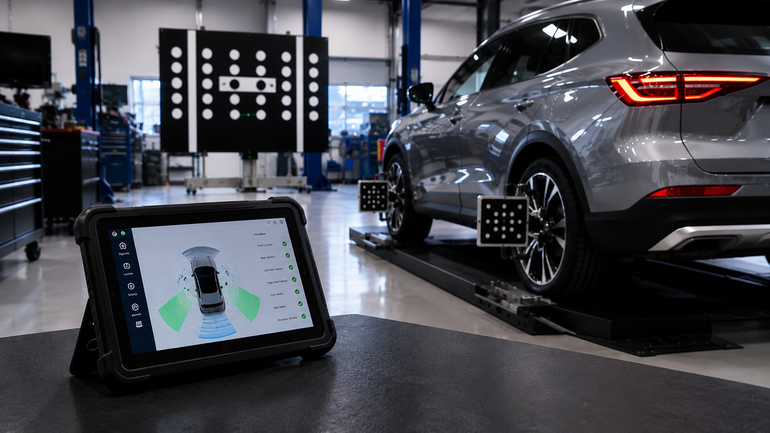
F or years, ADAS calibration has lived in a weird spot: essential to nearly every repair, but with no organized voice of its own. That just changed. On June 26, the Society of Collision Repair Specialists established an ADAS Repair Division with a five-member Governing Council, the first time the diagnostics and calibration community has had a dedicated home inside the industry's largest collision repair association.
If you sublet calibrations, do them in-house, or run a standalone calibration shop, this matters. Trade bodies don't build formal divisions around problems they think will fade. They build them around work that's becoming permanent, contested, and consequential. The formation of this Division, along with a parallel effort at the Collision Industry Conference, tells you where the standards, documentation expectations, and liability conversation are heading. It's worth understanding before those expectations land on your bay.
What SCRS Actually Created
SCRS approved the Division in 2025 in response to direct requests from ADAS specialists for a structured platform to close educational gaps and provide advocacy the sector didn't have. The Division operates within SCRS, is led by a Governing Council elected by the membership, and is charged with organizing programs, developing educational content, and representing ADAS professionals to the broader industry.
The Inaugural Governing Council
- ›Michael Ambrosino — ADAS Diagnostic Solutions; led Fuller Collision Group's move from in-house calibration to a multi-location diagnostic operation.
- ›James "Spike" Rodis — 39 years in the industry, 18 at Woodhouse Auto Family's OEM Calibration.
- ›Joe Brookhart — Summit Auto Calibration.
- ›Andy Dingman — Dingman's Collision Center; past SCRS chairman.
- ›Jason "Buck" Zeise — Regional director, Minnesota ADAS Solutions.
Notably, SCRS is charging the same membership rate to both collision centers and ADAS professionals, a deliberate signal that it sees these as two distinct but linked trades that need to work together. As SCRS Executive Director Aaron Schulenburg put it in the official announcement, the ADAS community voiced a clear need for a home within a trusted organization that understands the industry and can amplify their voice.
This Isn't Happening in a Vacuum
The Division is one of two industry moves aimed at the same problem. At the Collision Industry Conference in Charlotte this spring, chairman Dan Risley announced a new ADAS task force focused squarely on consumer risk. Industry consultant Sean Carey, who chairs the 11-member group, didn't soften the problem statement, telling attendees that thousands of cars are sitting in shops right now either incorrectly calibrated or with ADAS work left undone, and that the industry owes it to consumers to get that right, according to Autobody News' coverage of the two initiatives.
“Thousands of cars are sitting in shops right now either incorrectly calibrated or with ADAS work left undone.”
— Sean Carey, CIC ADAS Task Force Chair
Carey's framing is the part shop owners should sit with. His task force argues that without an industry-wide knowledge definition, critical safety procedures end up inconsistently executed and impossible to independently verify, which means cars are leaving shops every day incorrectly repaired. That's the liability thesis in one sentence. Work that can't be independently verified is work you can't defend later.
CIC has been careful to say it is not a standard-setting body. Risley stressed the task force exists to define the problem and surface possible solutions, not to write rules. But when two of the industry's most influential organizations independently decide, in the same season, that ADAS calibration needs a defined problem statement and a dedicated advocacy structure, the direction is clear. The loose, shop-by-shop era of "we calibrated it, trust us" is closing.
What It Means for Your Shop
None of this changes what you have to do on a repair order tomorrow. What it changes is the trajectory you're operating inside, and smart owners get ahead of trajectory.
Expect the definition of "done right" to tighten
Both efforts orbit the same idea: calibration work needs to be consistent and independently verifiable. That's a documentation standard in disguise. If your calibration reports today amount to a scan tool screen that says "complete," start building toward records that prove which systems you identified, why they required calibration, and how you confirmed success. That's the paper trail these initiatives are pointing toward, and it's what protects you in a comeback or claim.
Treat ADAS as its own discipline, not a bolt-on
SCRS just formalized what the best operators already knew: calibration is a distinct trade with its own skills, tools, and liability profile. Whether you keep it in-house or sublet, hold it to that standard. If you sublet, ask your calibration partner for the same verification documentation you'd want to defend in court. If you're in-house, make sure your targets, scan tools, and VCIs are current to OEM procedure, and that your techs can articulate the identification-to-verification workflow, not just run the routine.
Get a voice while the framework is still being built
SCRS is inviting ADAS businesses to join the Division through its website, and CIC is accepting industry input through a form on its site. The shops that show up now are the ones who help shape what "reasonable" and "standard" mean, before an insurer or a court defines those terms for them.
Bottom line
A scan-complete screenshot is not a defense. If it can't be independently verified, treat it as unfinished documentation.
Where This Leaves You
A trade association doesn't build a division for a niche. It builds one for a core function of modern repair. That's now what ADAS calibration is, and the industry is organizing to treat it that way, with clearer expectations for competence, consistency, and proof. The shops that thrive over the next few years will be the ones that already run calibration like the high-stakes, well-documented discipline it's becoming. The rest will be reacting to standards written without them in the room.
If you're building out your calibration capability, from targets and scan tools to a documentation workflow that holds up, we're happy to talk through what your shop actually needs. No pressure, just a straight conversation about getting it right.
