
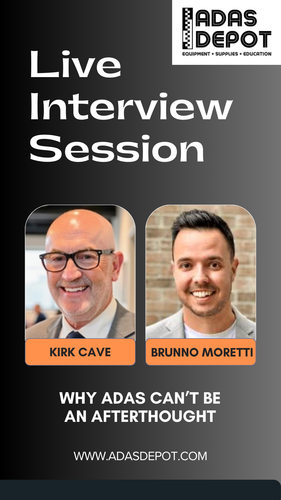
Most collision shops don’t hesitate to invest in structural repair equipment, welding systems, or paint technology. But when it comes to ADAS calibration, many are still unsure how aggressively they should move.
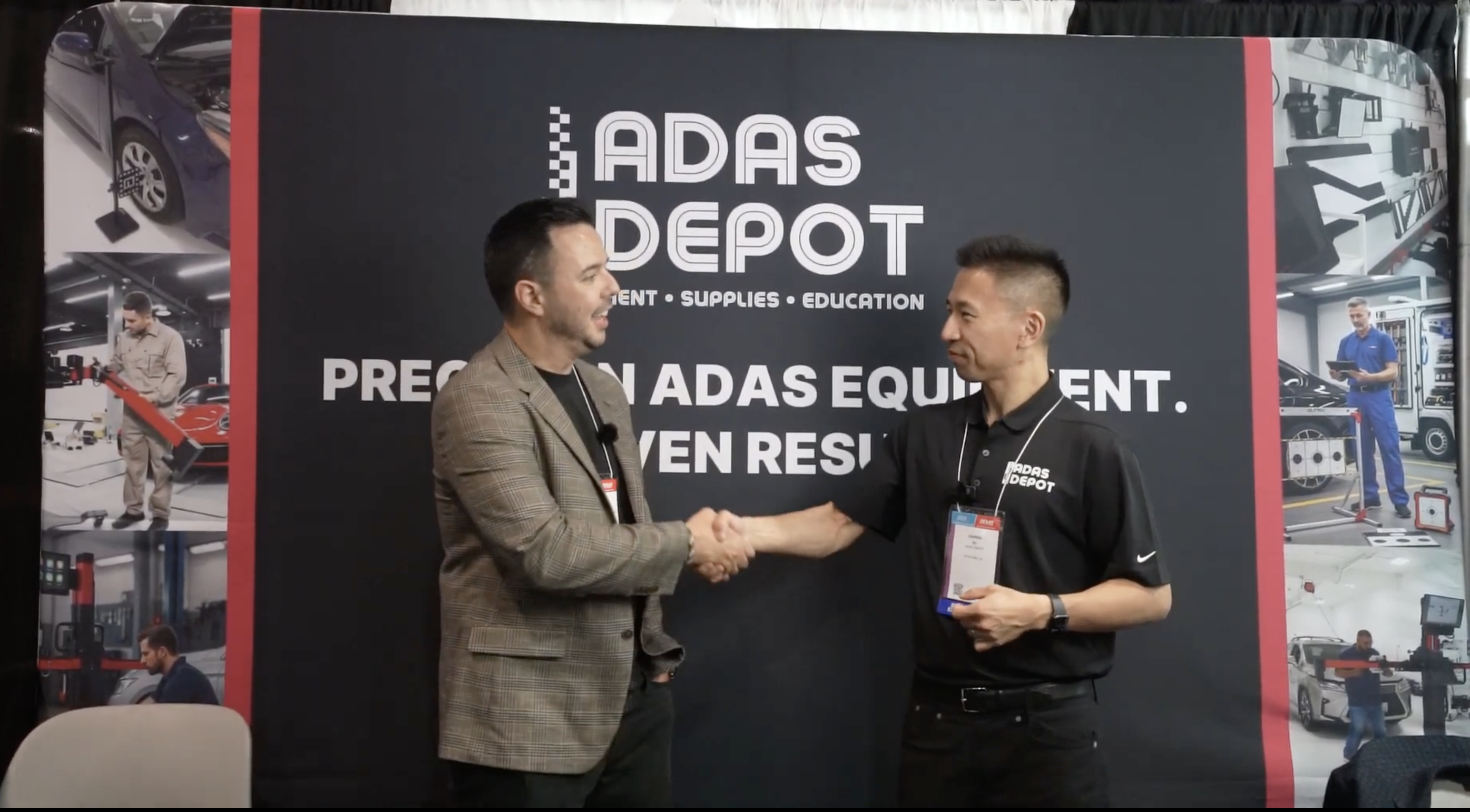
In a recent conversation, Kirk Cave of ADAS Depot sat down with Brunno Moretti, President of ADAS Aftermarket at Burke Porter, to talk about where the industry really stands.
Moretti brings a perspective that’s difficult to replicate. He spent a decade at General Motors working directly with ADAS sensor development and vehicle architecture before transitioning into his current role. Today, Burke Porter supports OEM production facilities around the world with end-of-line testing systems. In other words, he’s seen how these systems are engineered, validated, and released into production, and he understands what it takes to service them correctly after a collision.
One theme came up repeatedly during the discussion: ADAS is already part of standard repair work. As highlighted in our recent 2025 Calibration Survey Results, shops across the country are already seeing calibration volume become a routine part of collision repair.
Compliance or Business Strategy?
A common mindset in the industry is to view ADAS calibration as a compliance requirement, something that has to be done because insurers or OEM procedures demand it.
Moretti suggested that perspective may be limiting.
With roughly 94–95% of new vehicles equipped with some form of ADAS, and federal regulations such as FMVSS 127 raising performance requirements in the coming years, calibration volume is not trending downward. It’s becoming embedded in everyday repairs.
Shops that treat ADAS purely as an obligation often sublet the work. Shops that approach ADAS as a capability begin to see it differently, aligning with the mindset we outlined in Setting Up Success for 2026 in Vehicle Diagnostics and ADAS.
The Sublet Question
Subletting can be a practical short-term solution, especially for shops still evaluating volume. But it comes with trade-offs: margin is reduced, scheduling becomes dependent on outside providers, and workflow control is limited.
Moretti pointed out that shops that build strong in-house calibration programs sometimes become service providers themselves, supporting neighboring facilities that haven’t yet made the investment. What starts as internal capability can evolve into an additional revenue channel, a concept we explored further in How to Do ADAS Sales: A Practical Playbook for Calibrators.
The key difference isn’t whether a shop can perform calibrations, it’s whether they choose to integrate the process into their business model.
Liability and Documentation
Liability is often raised early in ADAS discussions, and for good reason. The repair facility is the last entity to service the vehicle before it returns to the customer.
Moretti’s view was practical rather than alarmist: follow OEM procedures and document thoroughly.
Pre-scans, post-scans, calibration reports, VIN documentation, measurement verification, and photo records all serve a purpose. Not just for repair quality, but for defensibility. If a repair is ever questioned, documentation demonstrates that procedures were followed correctly.
Documentation demonstrates that procedures were followed correctly. Many of the common documentation concerns are addressed in our guide, Most Common Questions in ADAS (And Answers).
Manual vs. Equipment-Based Setups
OEM procedures are intentionally written so calibrations can be performed without requiring proprietary systems. Manual methods using basic tools remain valid.
But validity and efficiency aren’t the same thing.
As Moretti explained, a manual front radar and camera setup may take around 20 minutes under normal conditions. Equipment-assisted systems can reduce that time significantly and improve repeatability.
For shops performing consistent ADAS volume, time savings directly affect cycle time and profitability. As insurer scrutiny around repair costs increases, efficiency becomes more important.
The Technician Conversation
Another topic that surfaced was staffing. Dealerships and independent shops alike continue to face technician shortages.
ADAS work, however, isn’t traditional mechanical labor. It involves diagnostics, software interaction, sensor alignment, and networked vehicle systems. The technical nature of calibration may actually appeal to a different segment of the workforce, individuals comfortable with technology and digital systems.
As vehicles continue integrating more cameras, radar units, and advanced control modules, the skill set required will continue evolving.
What’s Ahead
Over the next several years, ADAS systems will become more sophisticated. Higher-performing automatic emergency braking systems, expanded sensor coverage, and greater system integration are already in development.
Performance standards are increasing. Sensor density is increasing. Complexity is increasing.
While some self-calibration features are improving, post-collision calibration requirements are not expected to disappear. If anything, the precision required will likely increase as system performance expectations rise.
Moving Earlier vs. Later
Shops evaluating ADAS investment often focus on timing. When does it make sense to bring it in-house?
Moretti’s position was straightforward: the learning curve is easier when pressure is lower. Shops that integrate calibration earlier have time to refine workflow, train staff, and build documentation habits before volume and cost pressure intensify.
Waiting doesn’t eliminate the need, it simply compresses the timeline later.
Closing Thoughts
ADAS calibration is no longer an emerging trend. It’s integrated into modern vehicle repair. Each shop must decide how it wants to participate, whether as a sublet customer or as a capable provider.
The systems are already on the road. The repairs are already happening. The strategic decision is how much control a shop wants over that portion of its operation.
Watch the full interview here:
Building an ADAS Program
For shops evaluating equipment, workflow design, or in-house calibration strategy, ADAS Depot works with collision centers, dealerships, and glass operations to configure scalable setups based on volume and space requirements.
To discuss your ADAS equipment needs, contact ADAS Depot at (925) 566-8545 or sales@adasdepot.com.
