
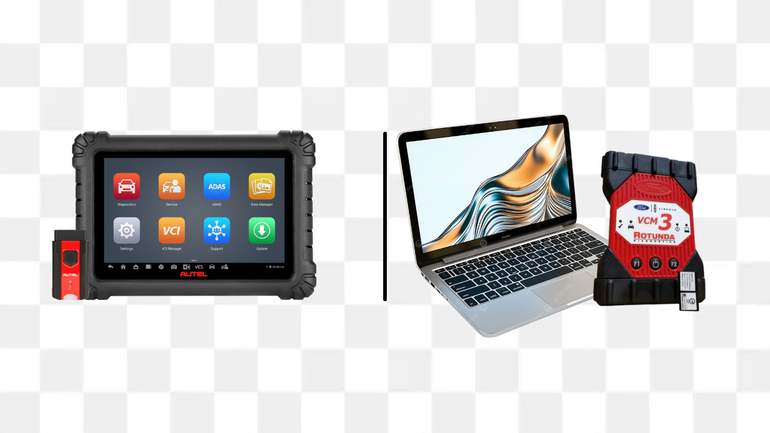
If you've spent any time in ADAS calibration, you've probably had this conversation. A shop owner is building out their diagnostic setup and wants to know: should I go aftermarket or OEM? The honest answer is that it's the wrong question. The shops doing this work at a high level aren't choosing one over the other. They're using both, and they know exactly when to reach for which one.
Here's a quick summary before we get into it:
|
Aftermarket Scan Tools |
OEM Scan Tools |
|
Wide vehicle coverage across makes and models |
Direct access to the same environment dealers use |
|
Faster software innovation and update cycles |
Required for module programming and flashing |
|
More accessible price point and ongoing support |
Better protection against liability on OEM-specified procedures |
|
Ideal for mixed-vehicle, high-volume workflows |
Essential for advanced calibrations gated behind OEM access |
What Aftermarket Tools Do Well
Aftermarket scan tools, the kind made by manufacturers like Autel, Launch, TOPDON, and others, are built for breadth. A single device can cover hundreds of makes and models, which makes them indispensable for any shop that sees a mix of vehicles. You're not buying a different tool for every brand that rolls through the door, and you're not turning away work because your equipment doesn't support a particular make. The Launch X-431 Throttle III, for example, covers U.S., Asian, and European vehicles from 1996 and newer, including exotics, that's the kind of range that keeps a mixed shop moving.
Beyond coverage, aftermarket tools tend to move at a decent pace on software updates for new model years, though they will certainly lag OEM tools, and are generally more accessible in terms of price and ongoing support. For the day-to-day work of running codes, performing resets, and executing ADAS calibrations across a diverse vehicle mix, a quality aftermarket tool is hard to beat. Most technicians who work across multiple brands will tell you it's the device they reach for first. If you're evaluating specific models, we put together a guide to the best scan tools for 2026 that breaks down the top options by use case.
These tools are also where most of the innovation in the diagnostic space is happening right now. Features like guided calibration workflows, integrated ADAS target positioning, and remote diagnostic capabilities have all come out of the aftermarket side of the industry. The development cycles are faster, the feedback loops between shops and manufacturers are tighter, and the result is tooling that keeps getting more capable year over year. You'd be surprised at some of the features that have quietly made their way into aftermarket scan tools over the last few years.
Where OEM Tools Fit In
OEM tools, software subscriptions sold directly by vehicle manufacturers like Ford's IDS, GM's GDS2, FCA's wiTECH, or Toyota's Techstream, give you something aftermarket tools can't fully replicate: direct access to the same diagnostic environment the dealer uses.
That matters more than people sometimes expect, and it shows up most clearly in specific situations. Programming and flashing modules is the clearest example. Many OEM systems require the factory tool to authorize and complete a programming procedure. Trying to do it with an aftermarket device can result in incomplete flashes, locked modules, or warranty complications that create more problems than they solve. If you want to go deeper on this, we wrote a full breakdown of OEM programming best practices that's worth reading before you tackle any programming job.
Certain advanced calibrations and resets on late-model vehicles are also gated behind OEM access, not because aftermarket manufacturers haven't tried to cover them, but because the OEM controls what gets exposed through the data link and what doesn't.
There's also a liability angle worth considering. When a repair involves a programming procedure or a calibration that has a direct OEM specification tied to it, being able to document that you used the factory tool adds a layer of defensibility that matters if something ever gets disputed down the line. For shops that take documentation seriously, which in ADAS work every shop should, OEM access is part of a complete paper trail.
If your shop works heavily on a particular brand, say you're seeing a consistent volume of late-model GM or Ford vehicles, an OEM subscription for that line can pay for itself quickly in jobs you'd otherwise have to turn away or sublet out.
The Real-World Setup
The practical approach most serious ADAS shops land on is a strong aftermarket platform as the backbone of their operation, supplemented by OEM subscriptions for the makes they work on most. The aftermarket tool handles the volume and variety. The OEM access handles the edge cases and programming work that requires it.
This isn't about redundancy, nor is it about spending more than you need to, we're trying to highlight what is pragmatic and will get the job done in a world of tradeoffs. There are jobs where only the OEM tool will get you across the finish line, and yet it can be impractical to sign up for every OEM's subscription (and pay some of those ransom-level annual fees). Being able to anticipate the types of vehicles you'll be working on before you're stuck mid-repair will save you real headaches. The cost of not having the right tool when you need it, in lost time, in sublet fees, in jobs that leave the bay unfinished, adds up faster than the cost of building the right setup from the start.
When Is OEM ADAS Scanning Required?
While aftermarket scan tools can perform many ADAS-related functions, there are situations where OEM ADAS scanning is the only recommended—or required—approach. Vehicle manufacturers continue to add security features, software requirements, and proprietary calibration procedures that require access to factory diagnostic platforms. As a result, many professional repair shops rely on OEM scan tools whenever a repair involves programming, advanced diagnostics, or manufacturer-specific calibration procedures.
Common situations where OEM ADAS scanning may be required include:
- Programming or flashing ADAS control modules
- Initializing replacement cameras or radar sensors
- Performing manufacturer-specific calibration procedures
- Accessing secure gateway modules
- Completing post-repair system verification
- Following OEM repair procedures after collision repairs
Using the manufacturer's diagnostic software helps ensure technicians are following the same workflow specified by the vehicle manufacturer, reducing the risk of incomplete programming, failed calibrations, or unsupported procedures.
Can Aftermarket Scan Tools Perform OEM ADAS Scanning?
In many cases, yes—but not always.
Modern aftermarket platforms from companies like Autel, Launch, and TOPDON can perform a large percentage of ADAS scans, calibrations, and service functions across multiple vehicle brands. For routine diagnostics and calibration workflows, these tools often provide the fastest and most cost-effective solution for independent repair shops.
However, there are still situations where only an OEM diagnostic platform can:
- Access the latest manufacturer software
- Authenticate through secure gateway systems
- Program replacement control modules
- Install factory software updates
- Complete OEM-only calibration routines
- Produce documentation that aligns with manufacturer repair procedures
This is why many high-performing collision centers and ADAS calibration shops build a hybrid workflow—using aftermarket tools for day-to-day diagnostics while turning to OEM software when factory-level access is necessary.
Why OEM ADAS Scanning Matters for Liability
ADAS features such as Automatic Emergency Braking, Lane Keeping Assist, and Adaptive Cruise Control depend on accurate communication between cameras, radar sensors, and electronic control modules. If a required scan, software update, or calibration is skipped—or completed with unsupported procedures—the system may not perform as intended.
By incorporating OEM ADAS scanning when required by the manufacturer, repair shops can better document their work, follow published repair procedures, and provide customers with greater confidence that the vehicle's safety systems have been restored correctly.
Building the Right Setup for Your Shop
The right combination depends on your vehicle mix, your volume, and where you want to take the business. A shop that sees a broad range of makes every week has different needs than one that specializes in a specific brand or vehicle type. There's no universal answer, but there is a consistently wrong approach: buying tools reactively, one job at a time, without a clear picture of what your shop actually needs to operate at full capacity.
At ADAS Depot, we carry a broad range of diagnostic and calibration equipment, both aftermarket and OEM, and we can help you think through what makes sense for your specific situation, whether you're building out a new setup from scratch or filling gaps in an existing one. If you want to talk through your options, reach out to us directly.
