
Shopping for TPMS (Tire Pressure Monitoring System) sensors can get overwhelming fast. Between budget-friendly universal sensors, mid-range programmable options, and premium OEM choices, it’s not always clear which one fits your needs — or your customer’s.
To make it easier, here’s a comparison based on sensors we’ve tested, installed, and trust in real repair environments.
Good: Off-Brand Budget Universal TPMS Sensors
For simple replacements where price matters most, universal sensors are often the starting point. These generic sensors are designed to cover a wide range of vehicles, and you’ll typically find them listed on Amazon, eBay, or bulk parts sites.
They can get the job done, but they come with trade-offs that repair shops and customers should understand.
Pros
- Very affordable
- Readily available online
- Work for basic use cases
Cons
- Communication issues with certain makes and models
- Battery inconsistencies, sometimes arriving weak or dead
- Lower build quality and unpredictable longevity
When to choose this option:
You need the lowest-cost replacement for a non-sensitive vehicle and are comfortable with the risk of reduced reliability.
Real-world example:
Off-brand universal sensors marketed as “fits most vehicles.” Always double-check vehicle compatibility and reviews before purchasing.
Better: Programmable Sensors from Trusted Brands
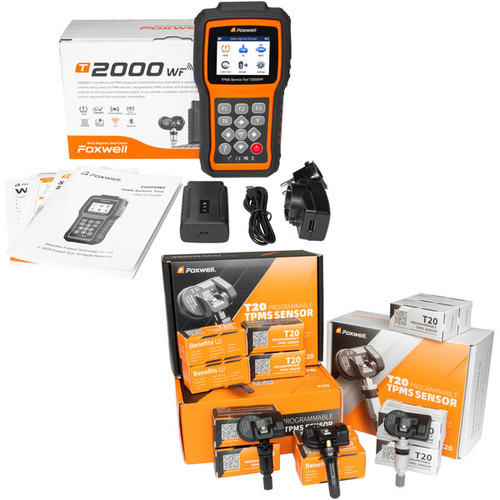
This tier is where quality and value start to meet. Brands like Foxwell, Autel, and XTool offer programmable TPMS sensors that work reliably across a wide range of vehicles with far fewer compatibility surprises.
These sensors are ideal for shops that want consistent results without OEM pricing.
Pros
- Good overall compatibility
- Durable materials and solid build quality
- Manufacturer support and documentation
- Often compatible with OEM relearn procedures
- Use high-quality internal batteries, which helps extend sensor life and reduces how often replacements are needed
Cons
- Higher price than budget universal sensors
- Requires a TPMS programming tool
Example from our testing:
These performed extremely well in our shop and stacked up closely against Autel’s MX sensors at a better price point. When paired with the Foxwell T2000F TPMS tool, programming is quick and straightforward.
When this tier makes sense:
You want reliability, strong coverage, and a sensor backed by a company that stands behind its products.
Best: OEM or OEM-Equivalent TPMS Sensors
For the highest accuracy and the smoothest communication with the vehicle’s onboard systems, OEM or OEM-equivalent sensors remain the top choice. Vehicles that are sensitive to TPMS specs, especially newer models and many luxury brands, tend to perform better with sensors designed to match OEM parameters closely.
As an authorized distributor of Autel, we recommend Autel’s OEM-equivalent TPMS sensors for shops that want factory-level reliability without the premium OEM price tag. Autel sensors deliver strong compatibility, accurate readings, and stable performance across a wide range of vehicles.
Pros
- Precise fit and communication
- Faster and easier relearn procedures
- High reliability with long service life
- Trusted by shops that need near-OEM performance
Cons
- Higher cost than universal or mid-range sensors
- OEM sensors for specific makes may still have limited availability
Example:
Autel TPMS Sensors (MX-Sensors) are engineered to perform at an OEM-equivalent level and designed for seamless integration with Autel’s TPMS programming tools. These sensors provide the accuracy, durability, and compatibility professional shops expect.
When this tier makes sense:
- Customers driving newer or more sensor-sensitive vehicles
- Shops that want to minimize TPMS-related comebacks
- Technicians who prefer smooth relearn processes
- Vehicles that struggle with universal or low-budget sensors
Quick Comparison Chart
Here’s a snapshot to help you decide quickly:
| Tier | Price | Reliability | Compatibility | Best For |
|---|---|---|---|---|
| Good | Low | Low–Medium | Unpredictable | Budget fixes, low-sensitivity cars |
| Better | Mid | High | Broad | Daily shop use, modern vehicles |
| Best (OEM-Equivalent) | Highest | Very High | Excellent across many makes | Professional shops, sensitive OEM systems, luxury brands |
If you run a repair, glass, or calibration shop, choosing the right TPMS sensor isn’t only about price. Consider:
- Your customer base (economy vs. premium vehicles)
- Your comeback rate tolerance (lower tier = higher comeback risk)
- Access to programming tools
- Shop workflow and efficiency
- Availability of sensors during peak seasons
High-quality sensors reduce repeat visits, save technician time, and improve customer trust.
Final Thoughts: What We Recommend
If cost is the main concern, universal sensors can be acceptable in simple cases.
If you want consistent performance without OEM pricing, mid-range programmable options like Foxwell offer strong value.
For the best accuracy, the most predictable relearn experience, and the highest compatibility across modern vehicles, Autel OEM-equivalent TPMS sensors are our top recommendation. As an authorized distributor, we trust these sensors for shops that want OEM-level performance without the OEM price point.
If you’re unsure which TPMS sensor fits your vehicle or workflow, our team is always happy to help.
Need Help Choosing the Right TPMS Sensor?
We match shops with the right sensors every day. Whether you want premium OEM performance or a dependable mid-range option, we can recommend the best fit based on your vehicle, budget, or fleet profile.
Contact us to get personalized guidance.
